














1 Gen3 Smart Relay
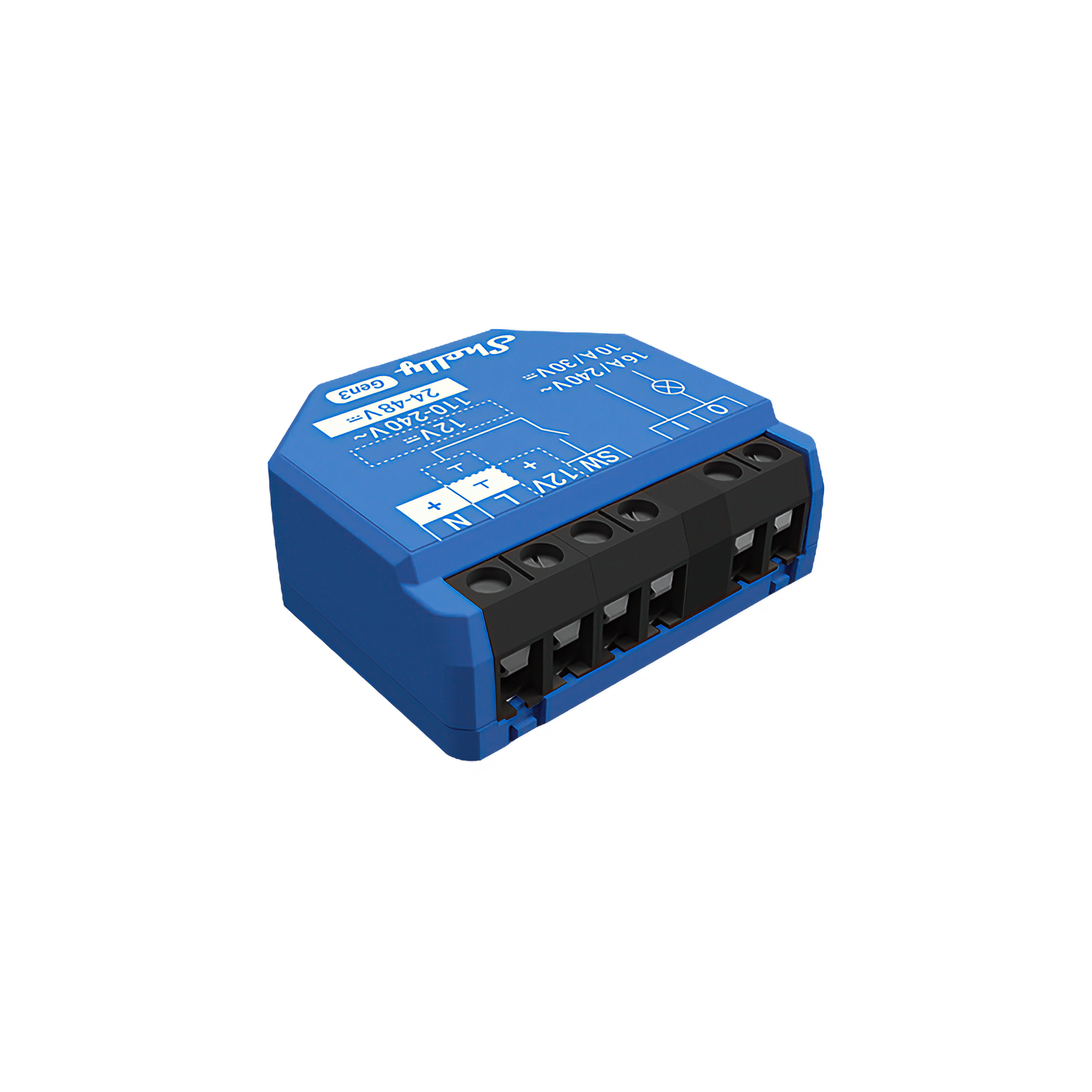
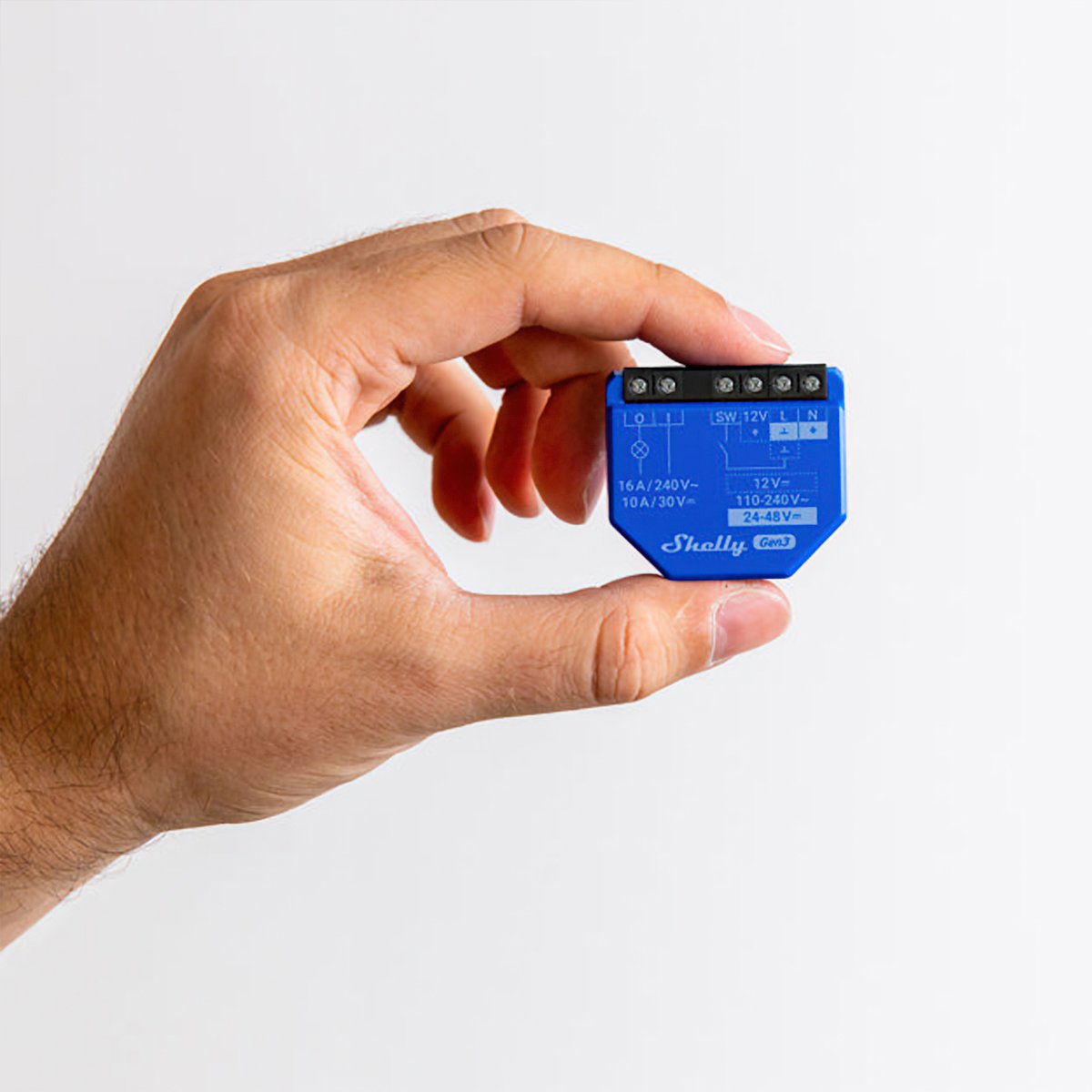
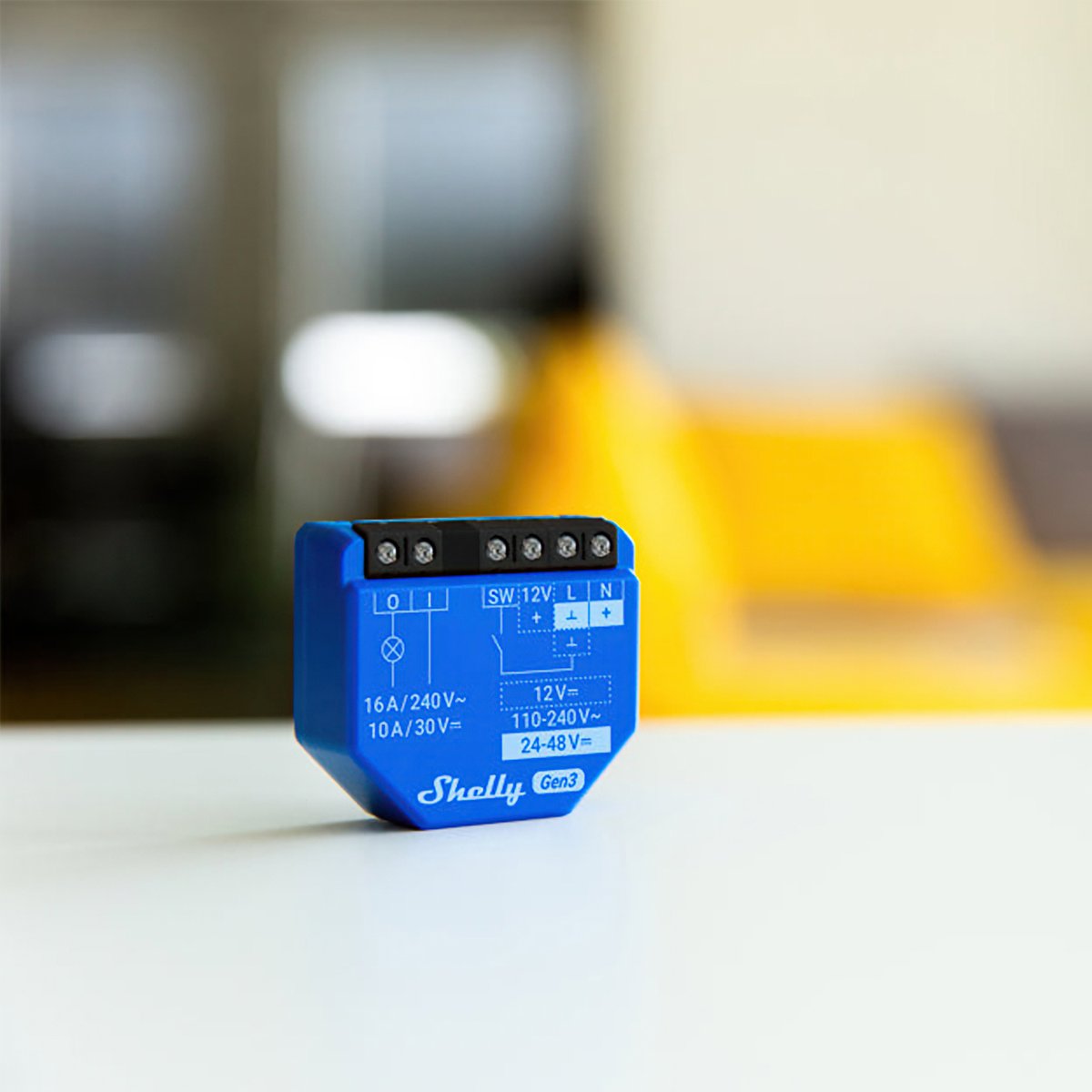
The Shelly 1 Gen3 is a compact Wi-Fi relay that hides behind an existing switch and adds app control, schedules and automations. Its dry-contact output also makes it the classic pick for garage doors and gates.
$24.95 inc GST In stock · ships today
Generation
Model guide
Which generation should I pick?
A generation is the brand's own version label. Newer usually means more ways to connect rather than a different device: Shelly's Gen4 adds Zigbee and Matter on top of the Wi-Fi and Bluetooth that Gen3 already had.
-
Gen3
Wi-Fi + BluetoothShelly's third-generation devices. Wi-Fi and Bluetooth, with a faster processor and more automation capacity than the Plus range they replaced.
Selected -
Gen4
Adds Zigbee + MatterShelly's fourth-generation devices. Adds Zigbee alongside Wi-Fi and Bluetooth, and works with Matter, so it pairs with Apple Home as well as the others.
Module Size
Filter guide
Which module size do I need?
Size decides where a module fits and whether it suits the space you have.
-
Standard
About 37 x 42 mmThe full-size in-wall module. Fits most Australian wall boxes and mounting brackets, and takes the most common wiring layouts without fuss.
Selected -
Mini
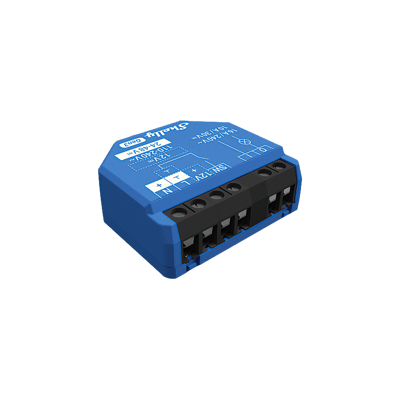
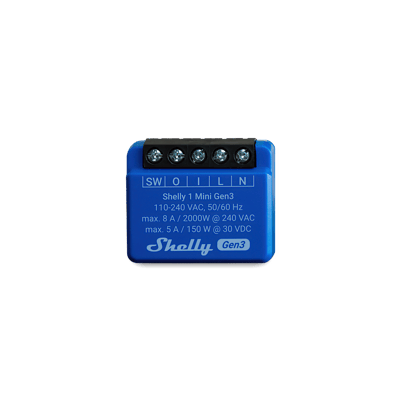
About 29 x 34 mmA shrunk version of the same module. Same job, smaller case, so it fits behind a mech in a wall box that is already tight for room.
Channels
Filter guide
What's a channel?
A channel is one output the device controls on its own. On a relay, each channel switches one circuit, so a 2-channel relay runs two lights separately. On an LED strip controller, each channel drives one colour line of the strip.
-
One channel
Switches one circuitSwitches one thing on its own: a light, a fan, an exhaust.
Selected -
Two channels
Switches two circuitsTwo circuits controlled separately, like both halves of a double switch.
Not available with Switching only.
Power Metering
Filter guide
What does energy monitoring do?
The relay measures how much power the circuit is drawing and reports it in the app, so you can see what a heater or pool pump actually costs to run and build automations around usage. Models without it still switch as normal; they just don't measure.
-
Switching only
No power measurementTurns the circuit on and off without measuring power use. Choose this where you only need control, not consumption data.
Selected -
Energy monitoring
Measures power useMeasures the power the connected circuit is using, so you can see consumption per device in the app. These are the models with PM in the name.
Currently sold out.
Free shipping over $150 Order before 3pm Melbourne time on a weekday and it ships the same day.
30-day returns Unused items, easy online returns
3-year warranty Backed by Shelly
Everything you need to know
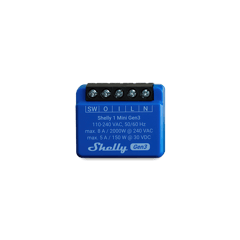
The Shelly 1 Gen3 is a single-channel Wi-Fi relay with a 16 A dry-contact output. It doesn't support Matter or Zigbee; for those, choose the Shelly 1 Gen4. It needs a neutral wire and a licensed electrician to install.
Product features
Smart control behind your existing switch
Fitted in the wall box behind a light switch or power point, the 1 Gen3 leaves your switch exactly where it is and adds app control, schedules and automations on top.
- Fits behind a light switch or power point
- Works with toggle and momentary switches
- Needs a neutral wire in the wall box
Dry contact rated to 16 A
Its output is a dry contact, which means it has no voltage of its own and simply opens or closes the circuit wired to it. That lets it switch mains loads up to 16 A or trigger a garage door opener or gate motor. For Matter and Zigbee support, we recommend the Shelly 1 Gen4 instead.
- Potential-free output
- Mains loads up to 16 A
- Fans and LED drivers need an RC snubber
Wi-Fi and Bluetooth, no hub needed
The Shelly 1 Gen3 connects straight to your Wi-Fi network, so there's no hub to buy, and works with Alexa, Google Home, SmartThings and Home Assistant. It can extend your Wi-Fi network and act as a gateway for Shelly BLU Bluetooth sensors.
- Works with Alexa, Google Home and Home Assistant
- Gateway for Shelly BLU sensors
- No hub required
Schedules and scripts run on the device
Up to 20 schedules and custom scripts run on the 1 Gen3 itself, so automations keep going if your internet drops. The built-in web interface lets you set everything up from a browser on your home network.
- Up to 20 schedules
- Scripting support
- Built-in web interface
What is a Shelly relay?

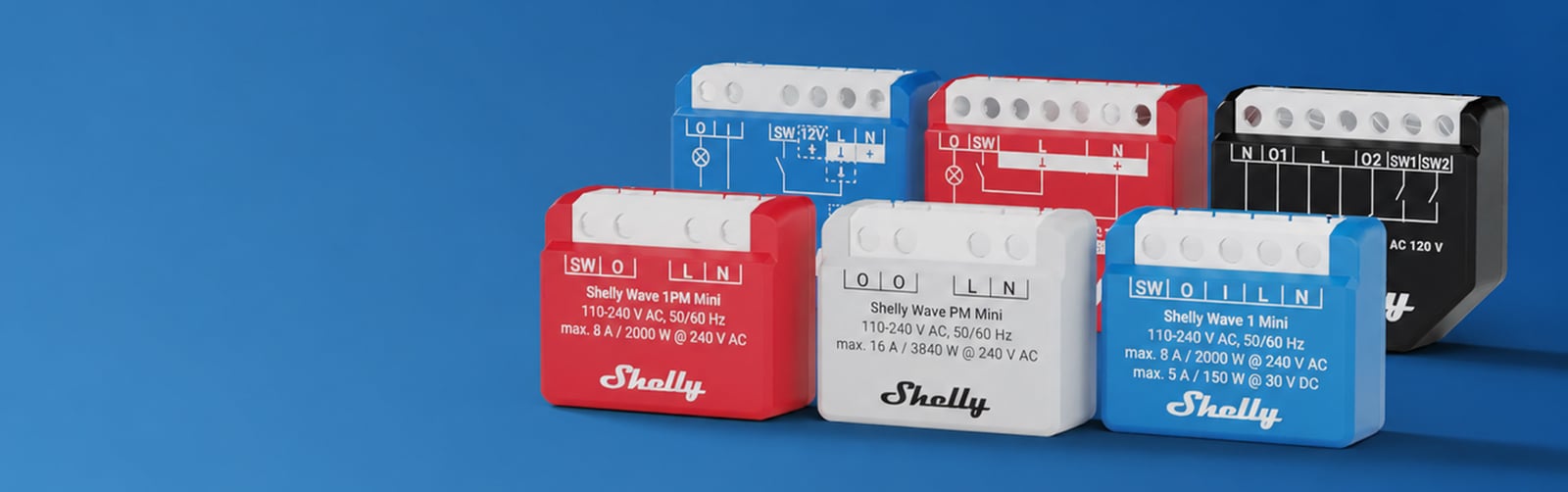
A relay is a small module that hides in the wall box behind a switch, or on the rail in your switchboard, wired in between the power and whatever it controls. That might be a light, an exhaust fan, a towel rail, a pump, or the motor that opens your garage door. Nothing on show has to change. The switch stays on the wall and keeps working exactly as it does now, and the same circuit can also be turned on from your phone, on a schedule, or by an automation.
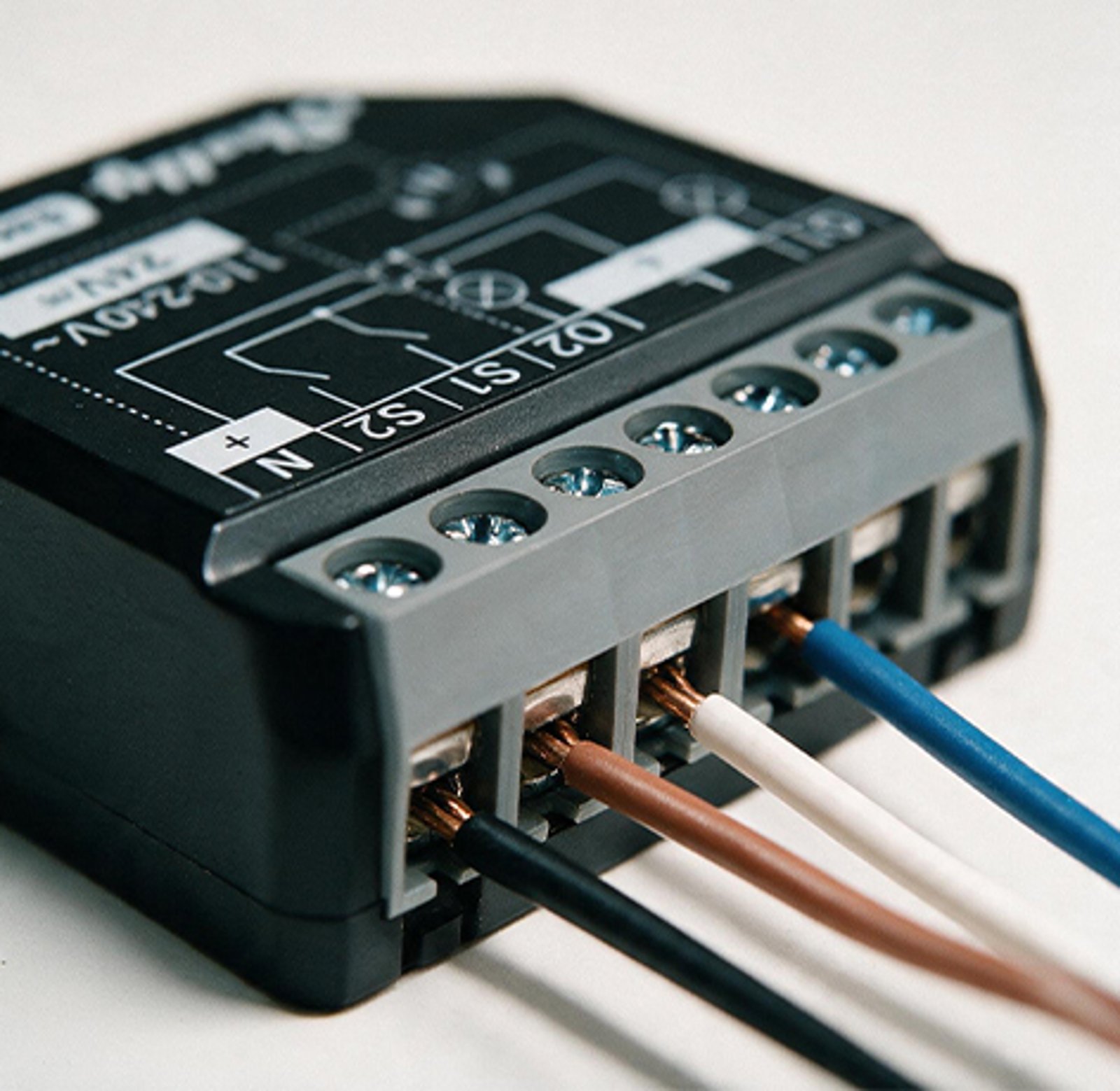
The number
One channel per circuit
The number in the name is how many things the module can switch on its own, from one up to four. A single light or exhaust fan takes a 1. A double light switch controlling two separate lights takes a 2, and each side still works on its own. The Pro 4PM goes up to four.
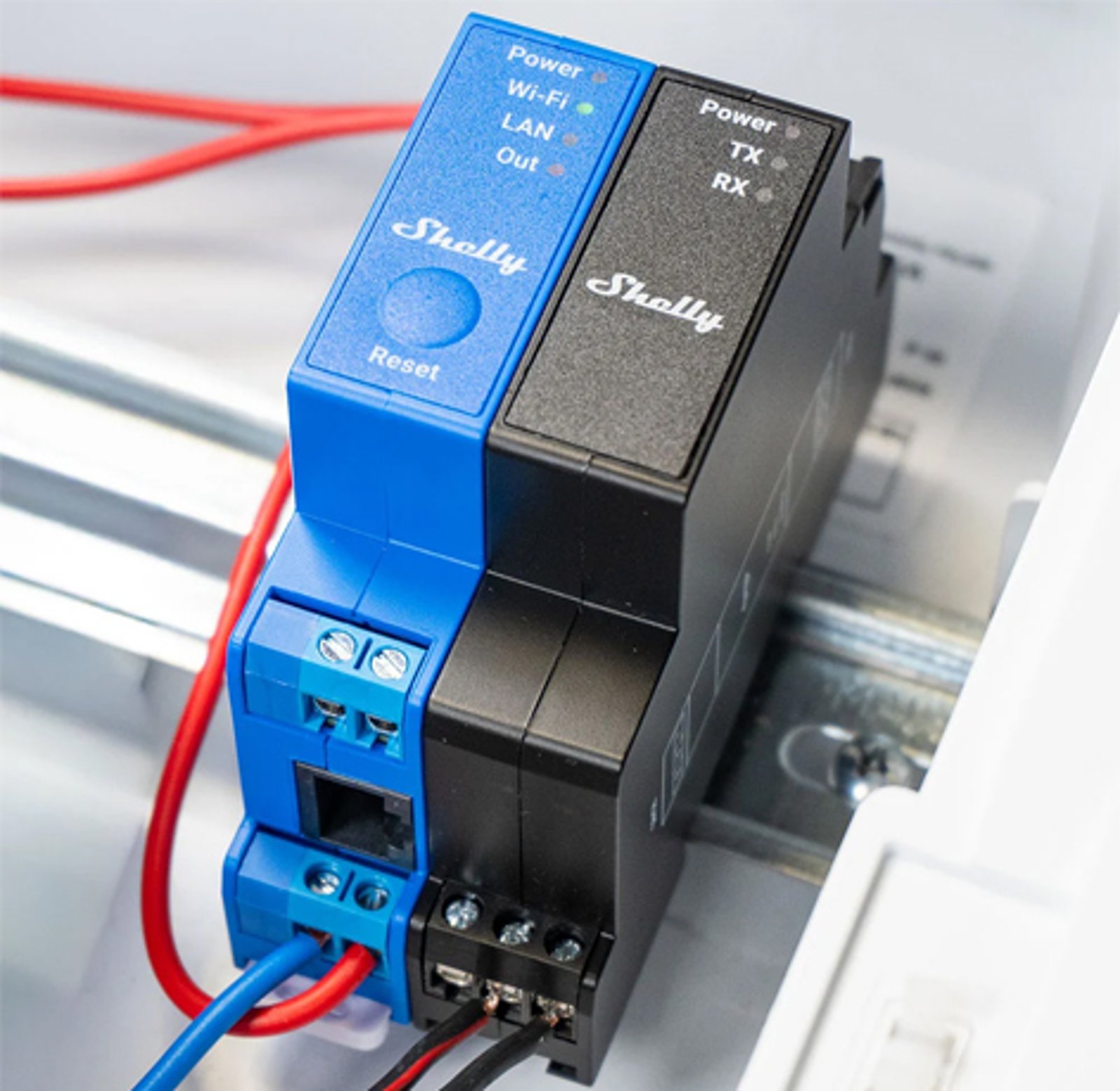
Pro and Mini
Where the module lives
Everything else in the name is about size and place. The standard module sits in the wall box behind your switch, and the Mini is a smaller version of it for when there is very little room left in the box. Pro units are built for the switchboard, clipping onto DIN rail, which is where whole circuits and three-phase work belong.
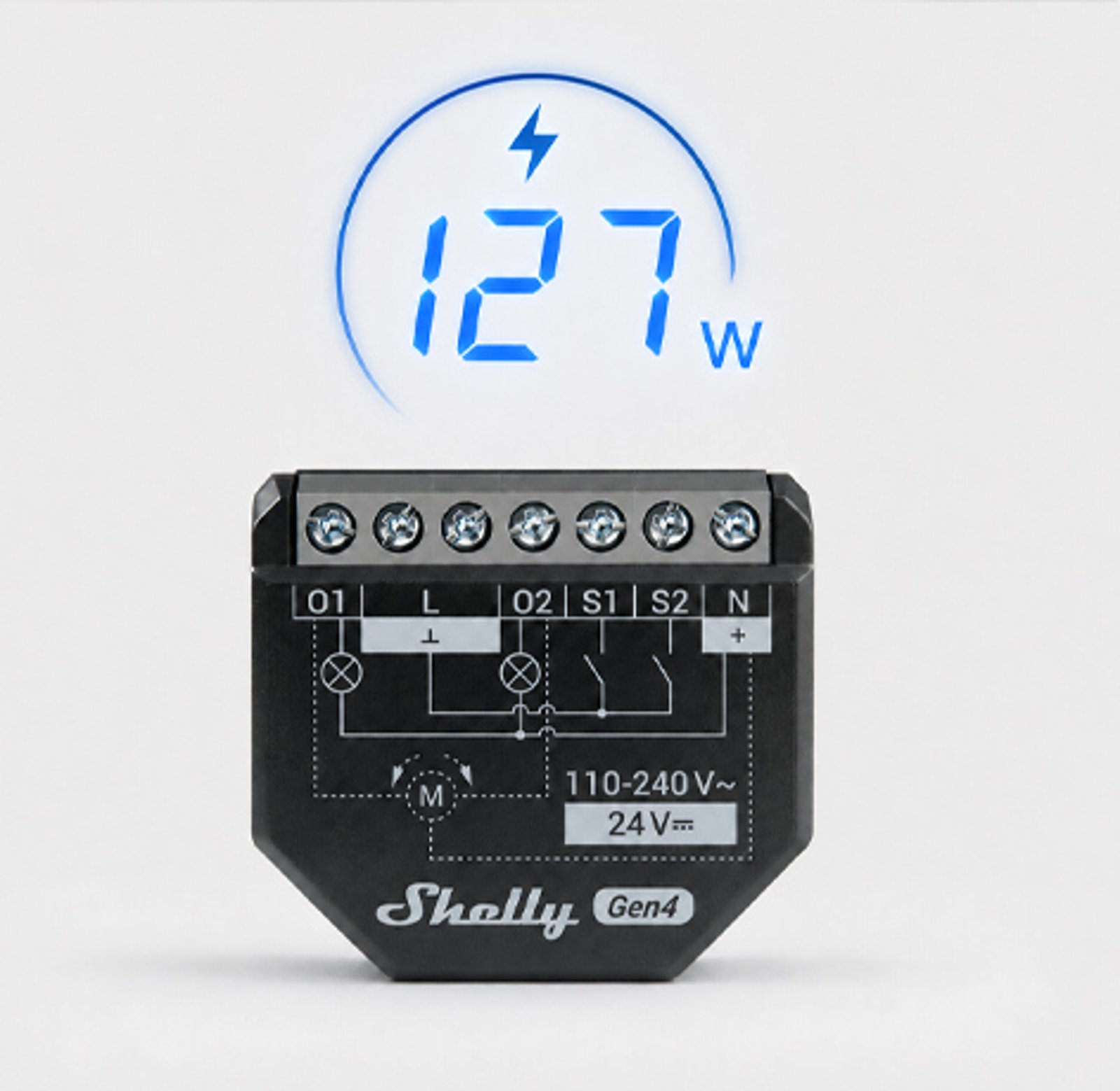
PM
What PM on the end means
PM is power measurement. Those models report what the circuit is drawing and the energy it has used over time, alongside the on or off state, so you can see what a heater or a pool pump actually costs to run. Models without PM switch the circuit and tell you nothing about it.
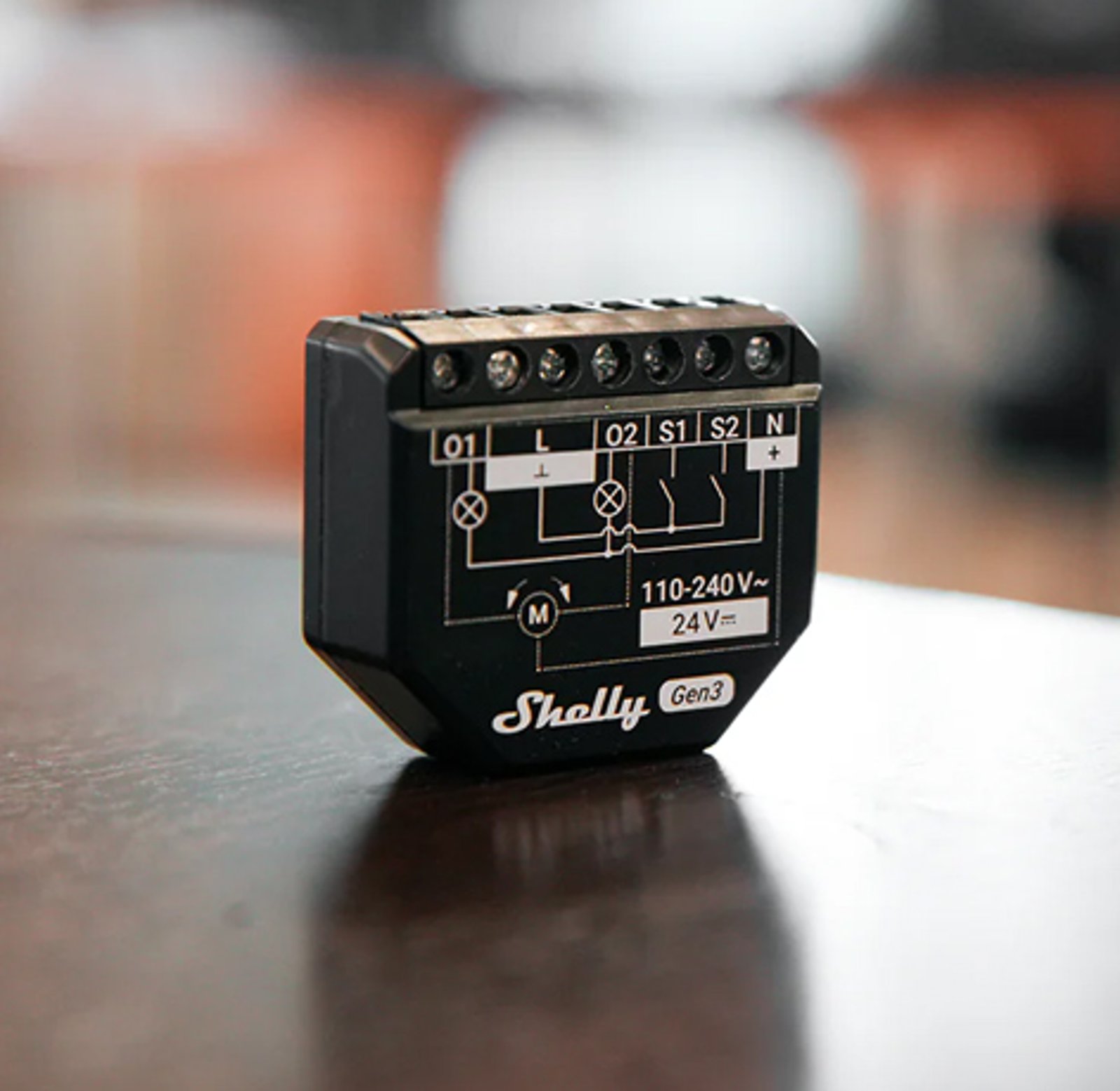
Gen 3 and Gen 4
What the generation changes
The generation tells you which protocols the module speaks. Gen 3 is Wi-Fi and Bluetooth. Gen 4 adds Zigbee and has Matter built in, though it runs one or the other, not both at once. The wiring, the app and the local control are identical. Pro units carry no generation in their name.
The existing controls
Nothing you already use stops working
The switch on the wall keeps doing what it has always done, and so does the button inside the garage. Whatever controls that circuit now carries on working, and the relay adds a second way in from an app, a schedule or a voice assistant. Nobody in the house has to change how they do things.
Smart bulbs
Smart lights that stay reachable
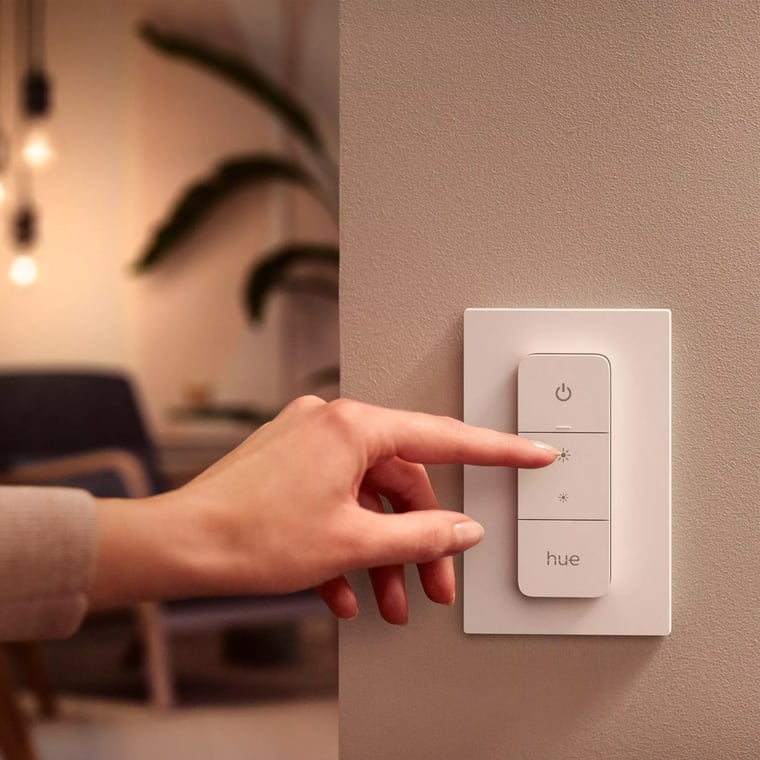
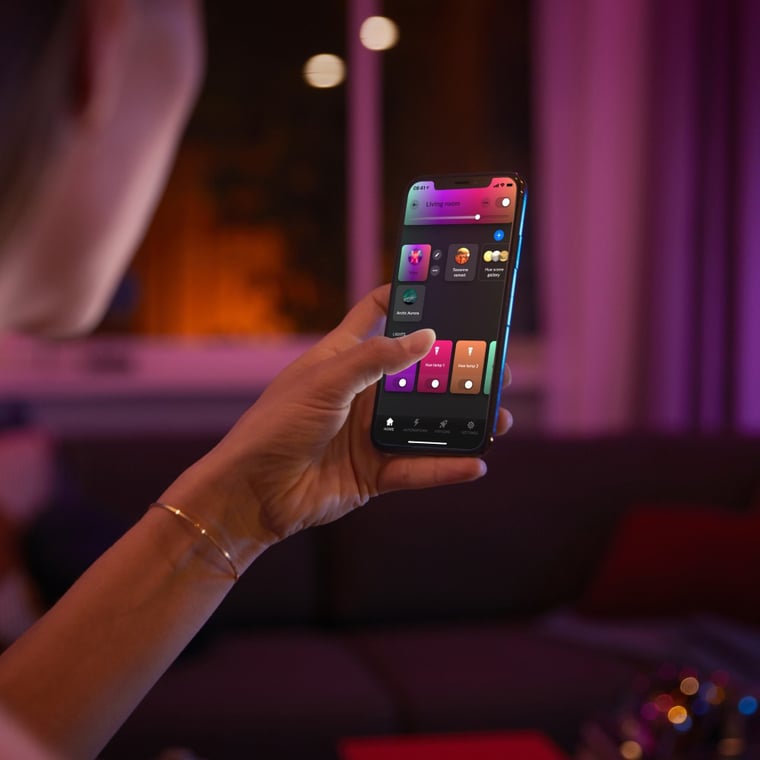
Smart bulbs only work while they have power, so one flick of the wall switch makes them unreachable via an app, like Philips Hue. Set the relay to Detached and the bulbs stay powered while the switch becomes a button your smart home can read, which is how a system like Home Assistant gets the switch and the bulbs working together again.
Works with
Also works with
-
Pairs with Amazon Alexa
-
Pairs with Google Home
-
Pairs with Home Assistant
-
Pairs with SmartThings
Connects over
On your Wi-Fi
Joins your home network, so you control it from the app with no hub or bridge.
-
Wi-Fi
Bluetooth
Used to set it up, and can also act as a gateway that connects Shelly's Bluetooth sensors, like the BLU Motion, to your network.
-
Bluetooth
Works offline
Keeps working on your home network when the internet is down.
Scripts
12
Give it jobs the app can't
Scripts add jobs the relay can't do with the Shelly app's schedules and actions alone, like acting on the weather forecast or sending an alert to your phone. Each one is a small program that runs on the relay itself: copy it, paste it into the device's script editor and press Start. It doesn't need a hub, a cloud account or a subscription.
-
Heating & hot water Cap how many hours a heater or pump runs each day -
Lighting Control a Philips Hue room from a wall switch -
Safety Garage door that closes itself after you forget -
Garden Garden watering that skips the run when it rains -
Safety Holiday lights that come on at a different time each night -
Heating & hot water Hot water or pool pump on off-peak times, with a boost switch
Scripts are free; installing one takes about two minutes.
Which relay do I need?
Gen3 is the value pick for everyday Wi-Fi setups. Gen4 adds an upgraded processor, Wi-Fi 6 and Zigbee. Matter is on out of the box, so it pairs with Apple Home, Google Home or Alexa directly, without the need for the Shelly app. Pro is built to go inside your switchboard, clipping onto the same DIN rail as your circuit breakers, and connects over Ethernet as well as Wi-Fi.
If you want a reliable relay behind a switch at the lowest price, and you run the Shelly app or Home Assistant over Wi-Fi, Gen3 does the job. For a new setup, Gen4 is the one we'd pick. If you already run a Zigbee network, Gen4 slots straight into it, and because every Gen4 relay is also a Zigbee repeater, each one you add extends and strengthens that network. A relay on Zigbee gives up Matter and its own settings page, so you choose which each one runs. And if you're searching for Gen2, it shipped under different names, the Plus and Pro ranges.
| Feature | Gen3 This model | Gen4 | Pro |
|---|---|---|---|
| Best for | Everyday Wi-Fi setups on a budget | New setups and Matter or Zigbee homes | Switchboards and bigger jobs |
| Connects over | Wi-Fi Bluetooth | Wi-Fi 6 Bluetooth Zigbee | Wi-Fi Bluetooth Ethernet |
| Matter | On some models, turned on in settings | Built in and on by default | Not supported |
| Mounting | Behind the switch or power point | Behind the switch or power point | DIN rail in the switchboard |
| Price from | $22.95 | $34.95 | $89.95 |
| Model | Generation | Module size | Channels | Energy monitoring | Price |
|---|---|---|---|---|---|
| Viewing: 1 Gen3 | Gen3 | Standard | 1 channel | No | $24.95 |
| 1 Mini Gen3 | Gen3 | Mini | 1 channel | No | $22.95 |
| 1 Gen4 | Gen4 | Standard | 1 channel | No | $34.95 |
| 1 Mini Gen4 | Gen4 | Mini | 1 channel | No | $34.95 |
| 1PM Gen3 | Gen3 | Standard | 1 channel | Yes | $25.95 |
| 1PM Gen4 | Gen4 | Standard | 1 channel | Yes | $39.95 |
| 1PM Mini Gen4 | Gen4 | Mini | 1 channel | Yes | $39.95 |
| 2PM Gen3 | Gen3 | Standard | 2 channels | Yes | $35.95 |
| 2PM Gen4 | Gen4 | Standard | 2 channels | Yes | $49.95 |
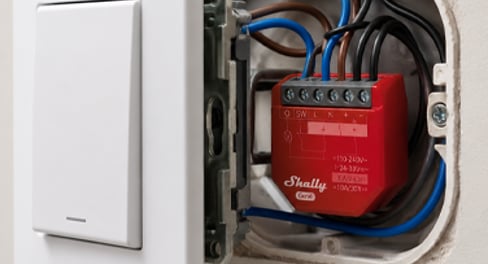
Behind the switch
Fits in the wall cavity behind an existing switch or power point. The switch on the wall stays and still works; the relay sits behind it and makes the circuit smart.
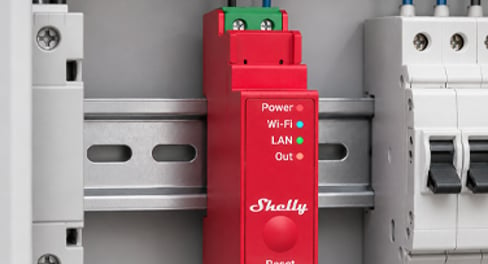
In the switchboard
Clips onto the standard rail in your switchboard, next to the circuit breakers. Keeps everything in one serviceable spot, which suits whole-home installs and bigger jobs.
Which generation should I pick?
A generation is the brand's own version label. Newer usually means more ways to connect rather than a different device: Shelly's Gen4 adds Zigbee and Matter on top of the Wi-Fi and Bluetooth that Gen3 already had.
Which module size do I need?
Size decides where a module fits and whether it suits the space you have.
What's a channel?
A channel is one output the device controls on its own. On a relay, each channel switches one circuit, so a 2-channel relay runs two lights separately. On an LED strip controller, each channel drives one colour line of the strip.
What does energy monitoring do?
The relay measures how much power the circuit is drawing and reports it in the app, so you can see what a heater or pool pump actually costs to run and build automations around usage. Models without it still switch as normal; they just don't measure.
Specifications & Installation
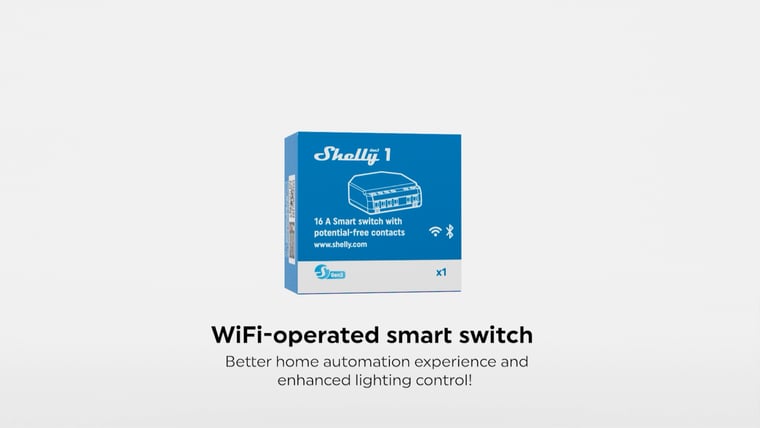
Setup · 2:07
How to install it
Shelly's own step-by-step install, from isolating the power to wiring L, N, O and the switch inputs.
Watch setup videoNo specifications match.
Build
- Type
- Module
- Module size
- Standard Also available: Mini
- Channels
- 1 channel
- Form
- In-wall
- Housing material
- Plastic
- Power
- Hardwired
- Supply voltage
- 110–240 V
- Standby power
- < 1.2 W
- Generation
- Gen3 Also available: Gen4
- Max current per circuit
- 16 A
- Neutral required
- Yes
- External protection
- Cable protection switch in accordance with EN60898-1 (tripping characteristic B or C, max. 16 A rated current, min. 6 kA interrupting rating, energy limiting class 3)
- Dry-contact mode
- Yes
- Energy monitoring
- No Also available: Yes
- Drives blinds & shutters
- No
- Local control
- Yes
- Standard
- 802.11 b/g/n
- Range (indoors)
- 30 metres
- Version
- 4.2 with BLE
- Range (indoors)
- 10 metres
- RF band
- 2400 - 2483.5 MHz
- Max. RF power
- < 4 dBm
- Operating temperature
- -20–40 °C
- Operating humidity
- 30–70 % RH
- Max altitude
- 2000 metres
- Size (HxWxD)
- 37x42x16 / 1.46x1.65x0.63
- Weight
- 26 g / 0.92 oz
- Screw terminals max torque
- 0.4 Nm / 3.5 lbin
- Conductor cross section
- 0.5 to 4 mm² / 20 to 11 AWG (solid, stranded, and bootlace ferrules)
- Conductor stripped length
- 6 to 7 mm / 0.24 to 0.28 in
- Mounting
- Wall console
- Shell color
- Blue
- Terminal Color
- Black
- Max. switching voltage
- * 240 V~ * 30 V⎓
- Max. switching current
- * 16 A/240 V~ * 10 A/30 V⎓
- Internal-temperature sensor
- Yes
- Protocol
- 802.11 b/g/n
- RF band
- 2401 - 2483 МHz
- Max. RF power
- < 20 dBm
- Range
- Up to 30 m / 100 ft indoors and 50 m / 160 ft outdoors (Depends on local conditions)
- CPU
- ESP-Shelly-C38F
- Flash
- 8MB
- Schedules
- 20
- Webhooks (URL actions)
- 20 with 5 URLs per hook
- Scripting
- Yes
- MQTT
- Yes
- SKU
- SHE-RLY-0001
- MPN
- S3SW-001X16EU
- Barcode
- 3800235261767
Wiring diagrams
Circuit overview
1Light / appliance2Wall switch
Active (supply)Neutral / 0 VSwitched loadSwitch signal / dry contact
In Australia, fixed 230 V wiring is licensed-electrician work. Use these diagrams to plan the job and brief your electrician.
Showing the whole circuit
What you can do with it

A warm towel rail on winter mornings
Schedule the rail for weekday mornings and it's warm when you step out of the shower, off again before you leave. No more discovering it's been heating an empty house all day. Control with any of

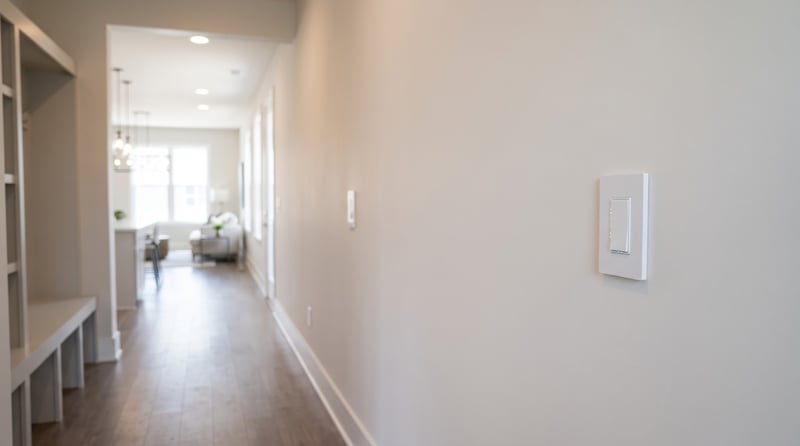
Add a second light switch without running new cable
A Shelly i4 behind a second switch tells the light to change over Wi-Fi, so the far end of the hall or the top of the stairs gets its own switch. Nobody runs cable between the two. Control with any of 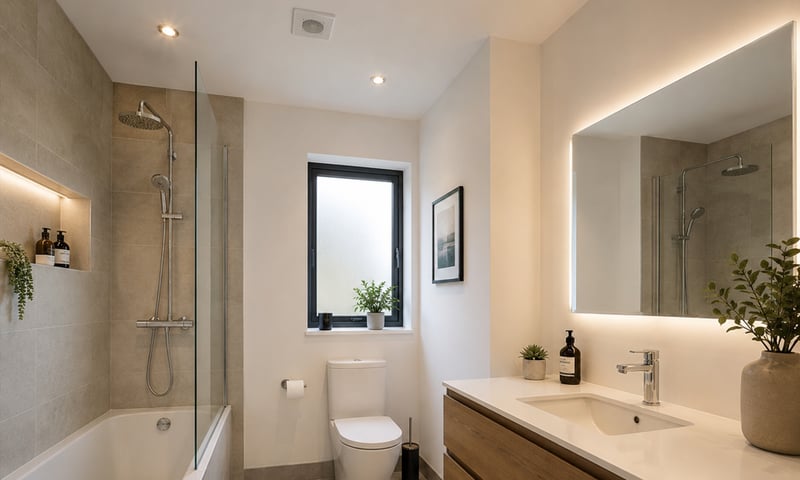
Bathroom fan that clears the steam, then turns itself off
The exhaust fan keeps running after the light goes off, long enough to clear the steam, then shuts itself down. Add a humidity sensor and it only runs when the room needs it. Control with any of 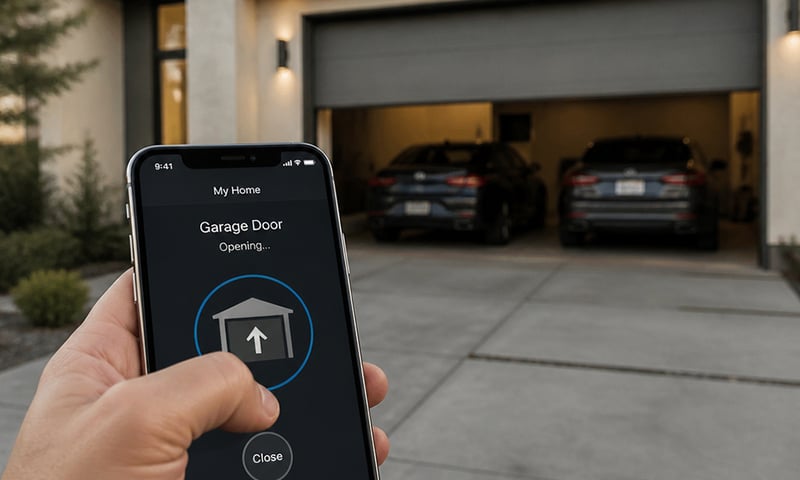
Open the garage door or gate from your phone
Wire the relay across the opener's button terminals and the roller door, swing gate or door release answers your phone as well as the wall button. Pair it with a contact sensor and you'll also know whether the door is actually shut. Control with any of 
Outdoor lights on at sunset, off at midnight
Porch, path and garden lights follow the sun through the year without you touching a switch. Run the lights you have from a Shelly relay, or fit Philips Hue outdoor lights, and set it up in their app or Home Assistant. Control with any of 

Water the garden on a schedule
The relay's dry contact drives standard irrigation solenoids, so beds and lawn water on a schedule without a dedicated controller. Rain coming? Skip the next run from your phone. Control with any of Common questions
Quick answers before you buy. We test this gear ourselves. Can't find yours? Ask our Melbourne team
Yes, though it's a small job. Shelly relays wire into 240V mains circuits, so in Australia a licensed electrician fits them, and a single relay doesn't take a sparky long.
Yes, this model needs a neutral at the install point. If your switch box has no neutral, look at the Shelly 1L or 2L instead: they're made for exactly that wiring.
No. It connects to your Wi-Fi and works from the Shelly app with no hub and no subscription. Schedules and automations run on the device itself, so they keep working if the internet drops out.
Yes. The output is a potential-free (dry) contact, so it can safely trigger garage door openers, gate motors and other low-voltage control circuits as well as switching mains loads.
Shelly · 1 Gen3 Smart Relay