











Gledopto
Zigbee controllers that put low-voltage LED lighting on the smart home you already run.
Gledopto makes one thing we care about: Zigbee 3.0 controllers that put low-voltage LED lighting on the smart home you already run. Deck lights, garden spikes, cabinet and plinth lighting, LV downlights, cove runs, LED strips. If it runs on 12 V or 24 V DC and has colour or white channels, one of these puts it in the app with everything else.
Pair one to a Hue Bridge, SmartThings or Home Assistant and the fitting behaves like any other light: colour, warm-to-cool white, dimming, scenes, routines. It answers a question Philips Hue can't. Hue makes bulbs and its own fittings. It doesn't make the deck lights around your alfresco, the strip in the kitchen kickboard, or the garden run down the side of the house, and those are the lights people actually want to bring in.
Three things worth being straight about before you buy. A Gledopto controller is an accessory, not a hub. It joins a Zigbee network, it can't run one, so you need a coordinator already: a Hue Bridge, a SmartThings hub, a Zigbee stick on Home Assistant. If you don't have one yet, start there.
It also only speaks low voltage. These sit between a DC power supply and the fitting, so they're for 12 V and 24 V lighting. A 240 V downlight or a mains fitting isn't the job for one of these.
And the controller itself has to stay dry. Both models are IP20, so they belong indoors: a cupboard, a cabinet, a ceiling cavity, or a weatherproof enclosure if the job is outside. The lights they drive can sit out in the weather all they like. The controller can't.
And a controller on its own won't light anything. You need three parts: the controller, the light, and a supply to drive it. We've set out what to buy below, including the one mistake that will cost you a controller.
Brand Gledopto 1 category · AU stock

Buying guide
Before you buy.
The one decision
Which one you need
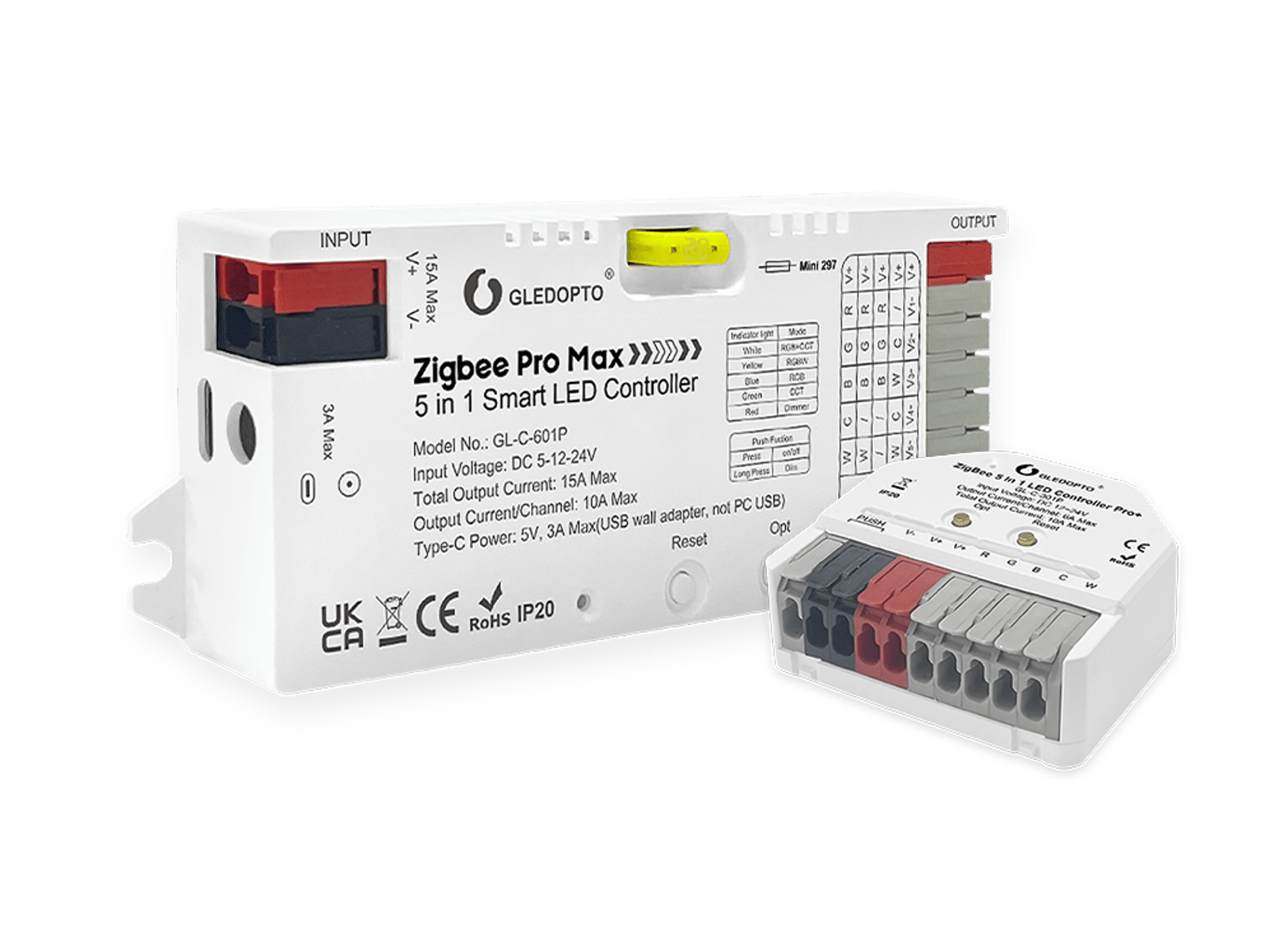
Same five channels, same Zigbee 3.0, same app. The difference is how much light you're driving and where the controller has to fit.
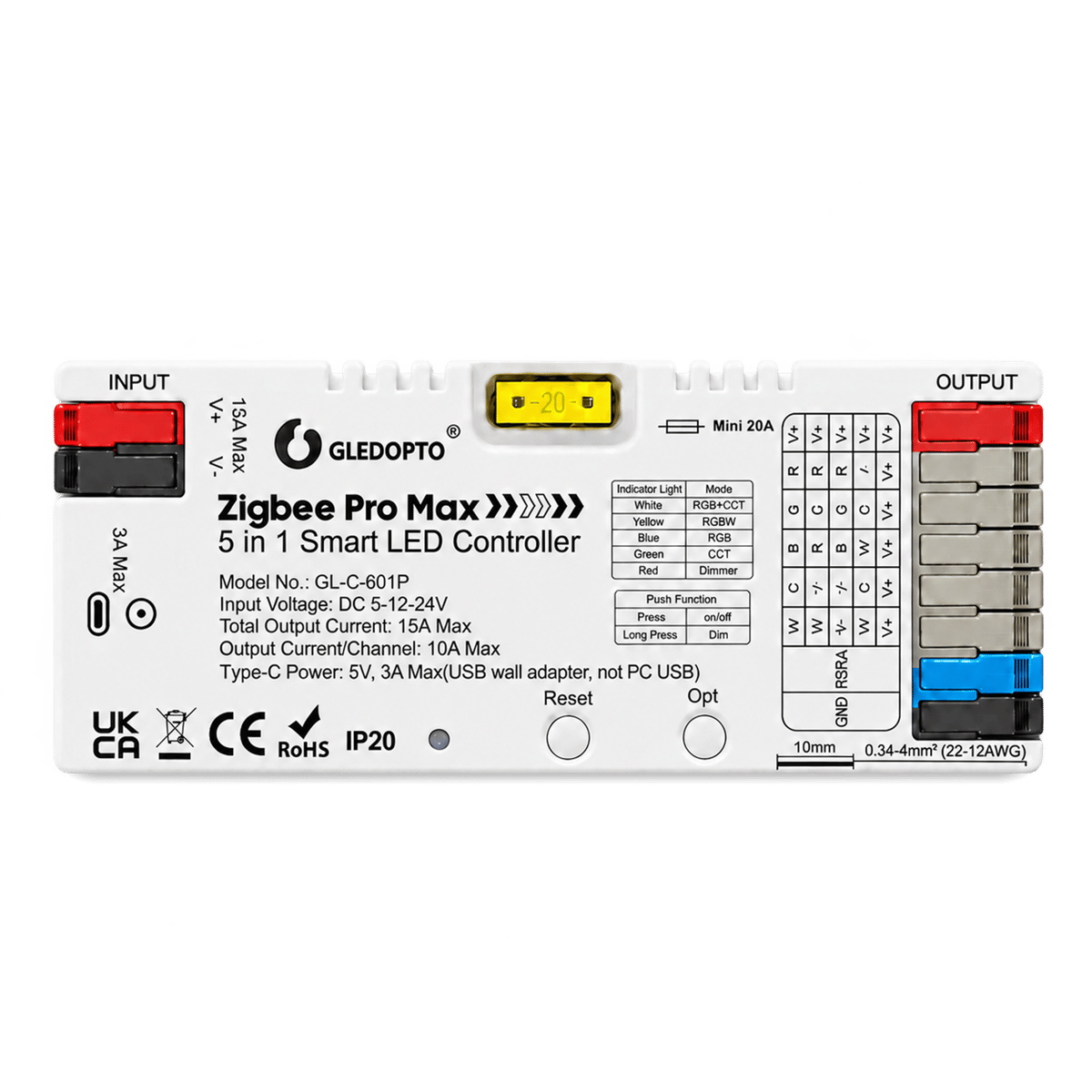
The Pro Max (GL-C-601P) carries 15 A total and 10 A per channel, takes 5 V, 12 V or 24 V, and accepts power through screw terminals, a DC barrel jack or USB-C. Buy it for long runs, for a whole-room or whole-deck job, or when you want the fuse and the headroom. At 129 x 50 x 23 mm it wants a cupboard, a cavity or a weatherproof enclosure.
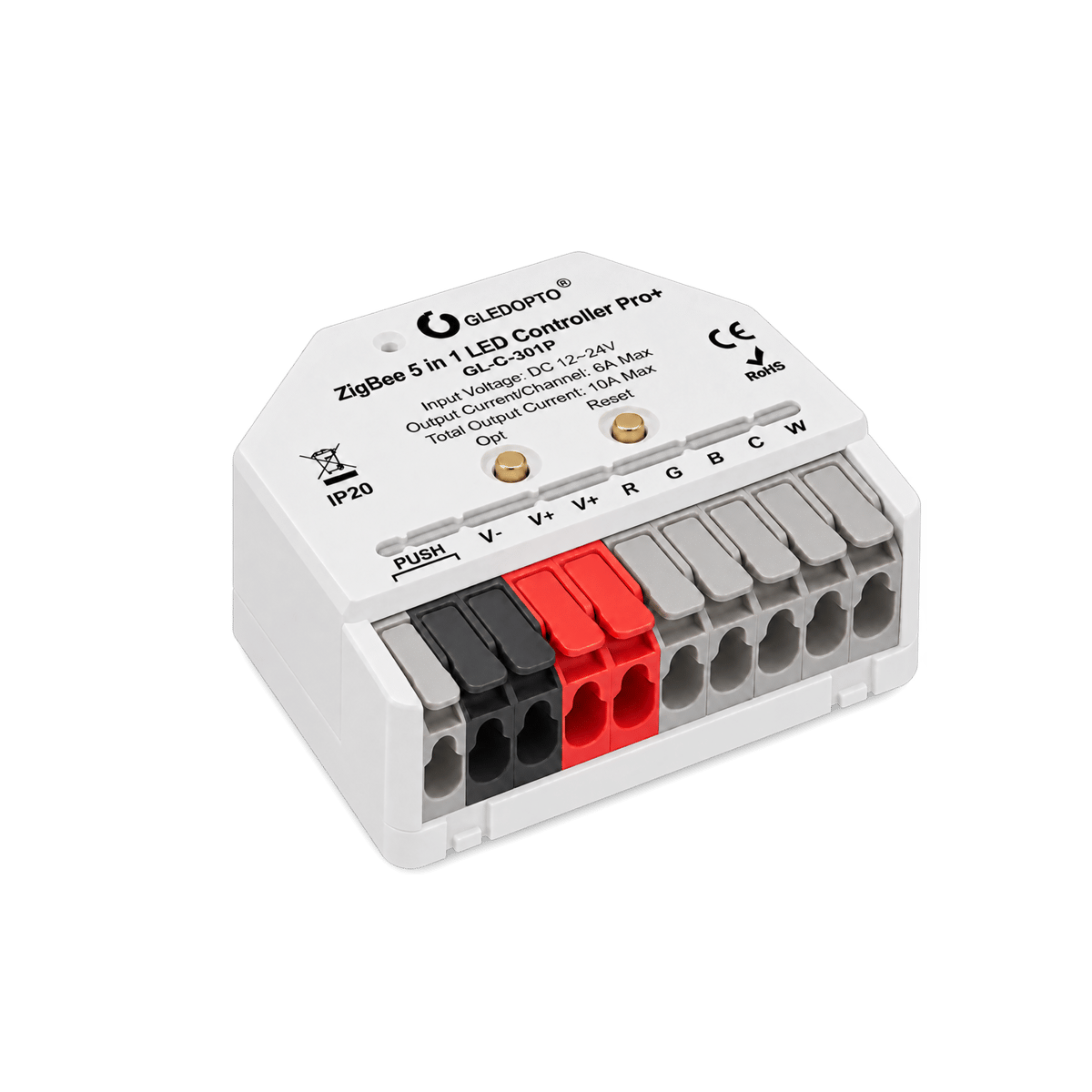
The Pro+ Mini (GL-C-301P) carries 10 A total and 6 A per channel on 12-24 V through terminals only. At 42 x 38 x 17 mm it tucks behind a cornice, into a cabinet plinth or above a ceiling panel. Buy it for a single run in a tight space.
If you're unsure, take the Pro Max. The extra $9 buys headroom you can't add later.
Pro Max
15 A total, 10 A per channel. 5 V, 12 V or 24 V, with terminals, barrel jack or USB-C. $44.95
Pro+ Mini
10 A total, 6 A per channel. 12-24 V, terminals only. Small enough to hide in a cabinet plinth. $35.95
5
channels: red, green, blue, warm white, cool white
Before you order
What else you need
A controller is one of three parts. Here's the rest of the shopping list, and the one mistake that will cost you a controller.
The lights themselves
RGB+CCT, 24 VFive channels means red, green, blue, warm white and cool white. Plain RGB fittings will work, but you'll lose the good whites, which is most of what you'll use day to day. We brought in BTF-Lighting's FCOB RGBCCT strips to run on these controllers: 24 V, six pins, dotless COB at 960 LEDs per metre, in 3 m and 5 m rolls. Go 24 V for anything over about 2 metres, because voltage drop on 12 V shows up as a dimmer, warmer far end, and it bites hardest on long garden and deck runs.
A constant voltage driver
The one that bitesConstant voltage, never constant current. A CC driver fights the controller's dimming and you'll get flicker, or nothing at all. Size it with room to spare: 5 metres of 18 W/m draws about 90 W, so a 150 W 24 V supply is the comfortable buy. Get one with a plug and a lead unless an electrician is wiring it in.
About the USB-C port
Pro Max onlyThe Pro Max takes USB-C and it's genuinely handy, but only at 5 V and about 15 W. That's a short accent run, not a room. Any real 12 V or 24 V install still needs a proper driver.
Common questions
Quick answers about Gledopto. We test this gear ourselves. Can't find yours? Ask our Melbourne team
Yes, on the Pro series. The controller pairs to a Hue Bridge like any other Zigbee light and shows up as a colour light you can put in rooms, scenes and routines.
Yes. It's a controller, not a bridge. It joins an existing Zigbee network and can't create one, so you need a Hue Bridge, a SmartThings hub or a Zigbee stick on Home Assistant already in place.
Anything low voltage: LED strip, deck and step lights, garden spikes, cabinet and plinth lighting, LV downlights, cove runs. The controller sits between a 12 V or 24 V DC supply and the fitting, so 240 V mains fittings aren't the job for one of these.
The lights can go outside. The controller can't, at least not unprotected. Both models are IP20, so an outdoor job means the controller sits inside, in a garage or a cupboard, or in a weatherproof enclosure rated for where you're putting it, with the low-voltage cable running out to the fitting from there.
Not these. Gledopto's Matter models are a different product, and Hue's Matter support doesn't accept third-party devices into the Hue app anyway. If the Hue app is the goal, Zigbee is the path.
Yes, on one channel, though you're paying for five. These earn their keep on RGB+CCT fittings where you want colour and adjustable white.
Yes. Mains-powered Zigbee 3.0 devices act as repeaters, so a controller strengthens the mesh rather than leaning on it.
Two years. Both carry a 24-month warranty. You deal with us rather than an overseas supplier, and your rights under Australian Consumer Law apply on top.
No. Gledopto also makes ESP32-based WLED controllers for addressable strips, and they're a different product line: Wi-Fi, flashed firmware, built for DIY pixel effects. The Pro series here is Zigbee 3.0 for standard RGB+CCT low-voltage lighting, and it pairs to a Hue Bridge, SmartThings or Home Assistant with no flashing or tinkering. We don't stock the WLED line.