











Calculator Ecosystems
Philips Hue bulb types: which fitting do you need?
Hue sells bulbs in five fittings in Australia, and the one already in your light decides what you can buy. How to tell them apart, and what Hue makes in each.
By Synced Updated 2 September 2026 7 min read

Question 1 of 2
What fitting does your light take?
Not sure? Take the old bulb out and look at the base: two side pins is bayonet, a screw thread is Edison, two straight pins is a spotlight.
On this page
The five fittings, and how to tell them apart
The fitting is not a preference. It is whatever is already in the light, and if you get it wrong the bulb will not go in. The quickest way to be sure is to take the old bulb out and look at the base.
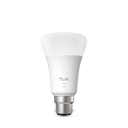
- B22 bayonet. A smooth metal base with two small pins on the sides. Push in and twist a quarter turn.
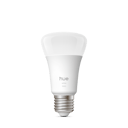
- E27 Edison screw. A wide screw thread, roughly the width of a 20c coin.
- E14 small Edison screw. The same thread in miniature, roughly the width of a 5c coin.
- GU10. Two stubby pins with flared tips. Push and twist to lock.
- MR16. Two straight thin pins. Push straight in, no twist. MR16 is the name of the 50 mm reflector shape and GU5.3 is the name of the base, so you will see both words on the packet.
Those five cover the Philips Hue range, but not every fitting in the country. Our guide to light bulb base types covers the rest, including the ones Hue does not make.
GU10 or MR16, and why this is the one that costs a return
These two are the same size, the same shape and usually sit next to each other on the shelf. Buying the wrong one is the most common mistake people make with downlights.
The pins are the tell. GU10 has two thick pins with flared tips that need a quarter turn to seat. MR16 has two straight thin pins that push in and pull out.
The faster check is the wiring, because it does not need the bulb out. If there is a separate transformer or driver box sitting above the ceiling next to the fitting, you have MR16. If the fitting is wired straight to mains with nothing in between, it is GU10. We go through the difference in more detail in GU10 vs MR16.
What Hue makes in each fitting, and what it does not
Hue's range is not the same width in every fitting, and the gaps are worth knowing before you plan a room around one.
Bayonet gets the standard A60 and the larger, brighter A67, both in all three light types, plus the G125 filament globe in White Ambiance. What bayonet does not get is any of the decorative shapes. The G95, the Triangle and the ST72 Edison are made in E27 and nowhere else, so if you want one of those the fitting has to change, not the bulb. That gap between the two ranges is the thing that catches most Australian buyers out, and buying Philips Hue in Australia goes through what it means for a whole house.
E27 gets everything. Both A-shapes in all three light types, the filament A60, the filament G125 globe, the filament ST72 Edison, and the shaped colour bulbs. If a Hue bulb exists, there is an E27 version of it.
E14 gets two shapes, the Candle and the Luster, each in White Ambiance and in colour. There is no plain White E14 at all, so the cheapest Hue bulb in that fitting is a White Ambiance. Check the shade clearance before you order, because the Candle is the taller of the two.
GU10 gets one bulb at 400 lumens, in White Ambiance or colour. MR16 gets a 400 lumen White Ambiance and a 320 lumen colour version. Neither has a plain White.
Add that up and plain White exists in two fittings only, B22 and E27, and only in the A60 and A67 shapes. Every other fitting starts at White Ambiance.
White, White Ambiance or colour
Hue sells three tiers and they stack, so each one does everything the one below it does.
White is a single fixed warm white, dimmable from the app or a switch. It is the cheapest Hue bulb and it is the right answer in a garage, a laundry or a hallway.
White Ambiance adds the full white range, roughly 2200 K at the warm end through to 6500 K daylight. Worth the difference in a bedroom or a study, where the same light needs to do two jobs at different times of day. If you are not sure which end you want, warm white vs cool white is the shorter version of that question.
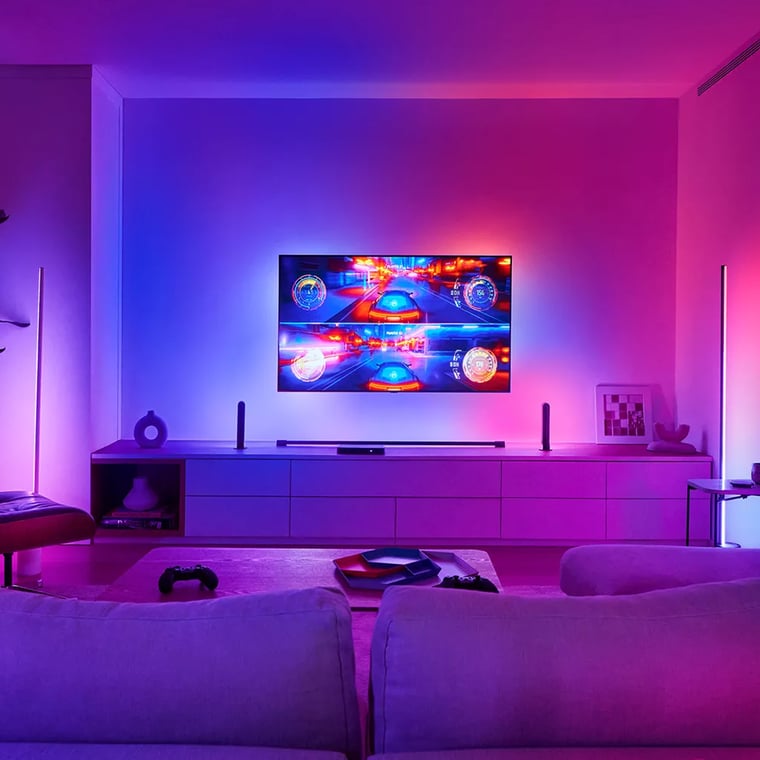
White and Colour Ambiance adds colour on top. It is the tier people buy for a living room or behind a television, and the one that costs the most in every fitting that has it.
The MR16 transformer problem
An MR16 does not run on mains. It runs on whatever the transformer above your ceiling gives it, and that transformer was almost certainly sized for a 50 W halogen. A Hue MR16 draws about 5 W. Give a transformer that wants a large load a very small one and you get flicker, buzz, or a light that will not start at all.
Philips' own advice for Australia is specific. Check that the existing bulbs are 12 V rather than 230 V. Check that the transformer is an LED transformer with no minimum load. Then check that the bulbs together stay under its maximum, which is generous once the numbers are small: a 20 W LED transformer will run three Hue MR16s.
If what is up there is a halogen transformer rather than an LED one, Philips says to take 20 per cent of its rated maximum and divide by the bulb's wattage. On a 60 W halogen transformer that leaves 12 W to play with, so two Hue MR16s at about 5 W each, not twelve.
If yours will not do it, the fix is an electrician swapping the transformer or the whole fitting. Philips does sell an MR16 transformer for exactly this job. Either way it is worth finding out before the bulbs arrive rather than after.
If your fitting is not on this list
Plenty of Australian lights take no bulb at all. Integrated LED downlights have the LEDs soldered onto a board, and a lot of newer pendants and ceiling lamps are built the same way. There is nothing to unscrew, so the smart part has to come from the fitting instead of the bulb.
Hue makes both. The Hue downlights replace the whole fitting rather than a bulb inside it, and the Hue ceiling lights are complete lamps with the light built in. If the fitting does take a bulb and you already know which one, the Hue bulbs range is the shorter path.
Frequently asked questions
What type of bulbs work with Philips Hue?
Every Hue bulb is a Hue bulb, so the question is really which fitting you need. In Australia Hue sells B22 bayonet, E27, E14, GU10 and MR16. Ordinary bulbs from other brands do not become Hue bulbs, and Hue bulbs do not need a special fitting.
Are E14 and E27 the same?
No. They are the same kind of screw thread at two different sizes, 14 mm and 27 mm across. An E14 will spin loose in an E27 socket and an E27 will not go into an E14 at all.
What is the difference between Hue E26 and E27 bulbs?
E26 is the American version of the same Edison screw, a millimetre narrower. The size is not the part that matters here: US Hue bulbs are built for 120 V, and the Australian range is 220 V to 240 V. Buy the local one.
How do I tell which type of light bulb I need?
Turn the light off, take the old bulb out and look at the base. Two side pins is bayonet, a wide thread is E27, a narrow thread is E14, two flared pins that twist is GU10, two straight thin pins is MR16.
Does Hue make a plain White bulb in every fitting?
No. Plain White only comes in B22 and E27, in the A60 and A67 shapes. In E14, GU10 and MR16 the entry point is a White Ambiance.
Still need a hand?
We answer most messages within one business day. If your question is about an existing order, have your order number ready. It speeds things up.
Contact us