















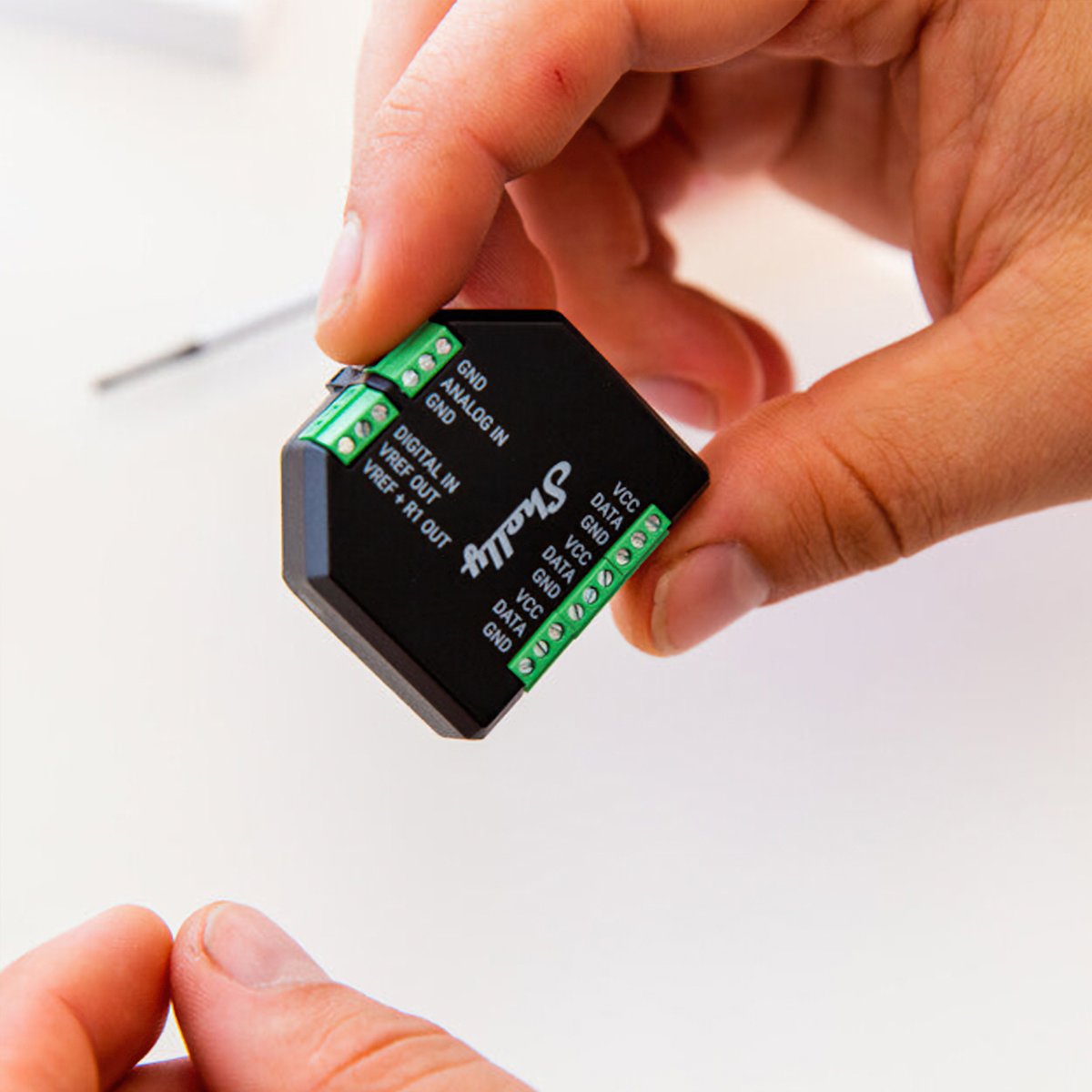

Plus Add-On
A sensor interface for a Shelly you've already installed. It adds temperature, humidity and analogue sensor inputs to a relay or dimmer in the wall, so the device can act on what it measures instead of only what you tell it.
$26.95 inc GST In stock · ships today
Currently sold out.
Free shipping over $150 Order before 3pm Melbourne time on a weekday and it ships the same day.
30-day returns Unused items, easy online returns
3-year warranty Backed by Shelly
Everything you need to know
The sections below cover what this add-on does, the sensors it takes, the full specifications, and how warranty and returns work. If something's still unanswered, the questions at the bottom cover the common ones.
Product features
What this add-on does
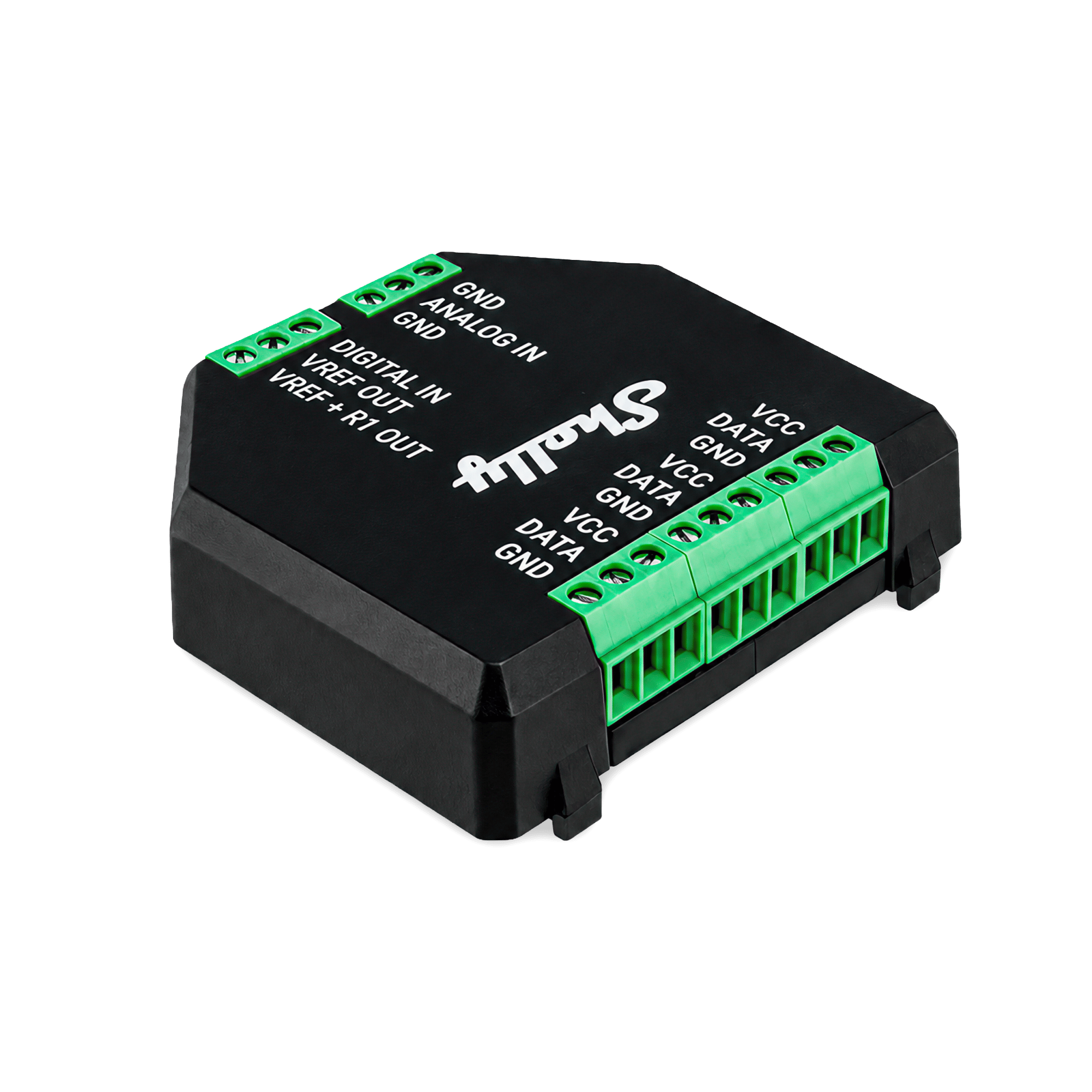
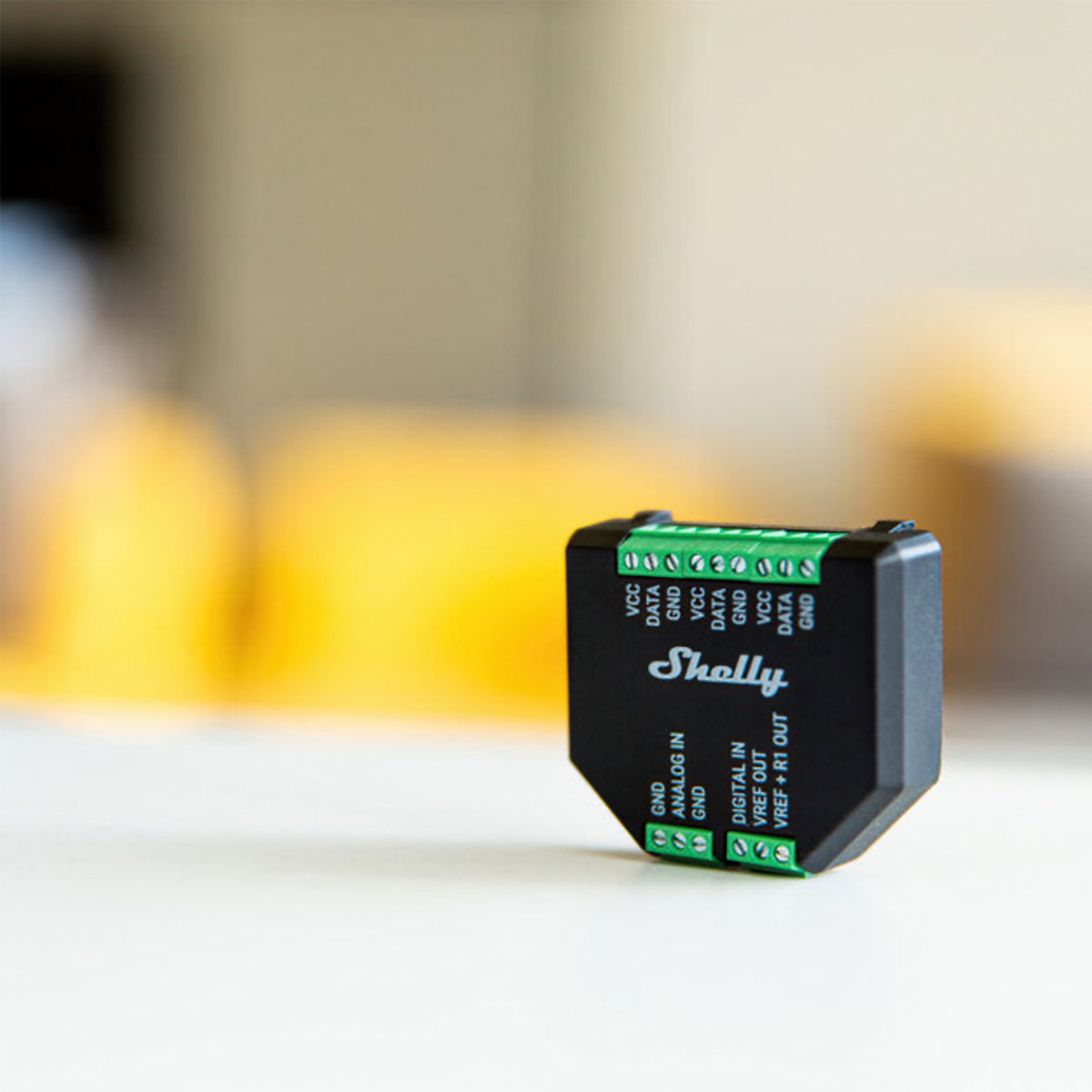
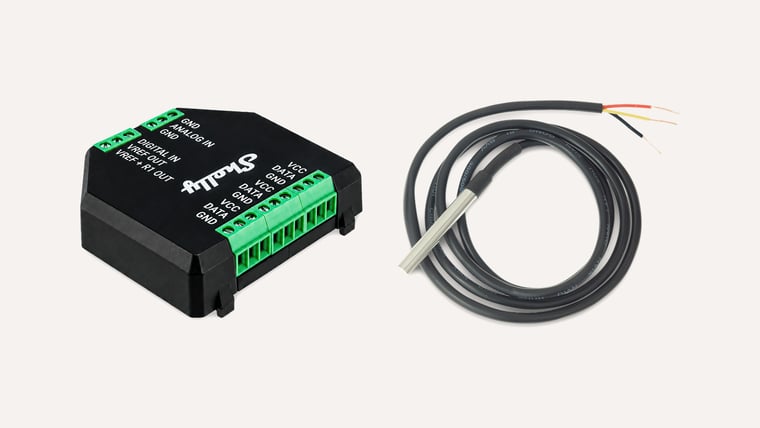
The Add-On is a sensor interface, and nothing more. You wire a temperature probe or another sensor into it, clip it onto a Shelly that's already in the wall, and it passes the readings across to that device. It has no logic of its own and it switches nothing. What happens with the reading is up to the host Shelly. A Shelly 1 Gen4 can hold a rule like "switch on below 20 degrees" and drive its own output, or it can pass the reading on to your app or home automation system. The sensor wires into the relay rather than into a hub, so there's no separate sensor to pair and nothing new on your network.
- Passes sensor readings to the Shelly it's attached to
- The host device holds the rule and does the switching
- No hub, no pairing, nothing new on the network
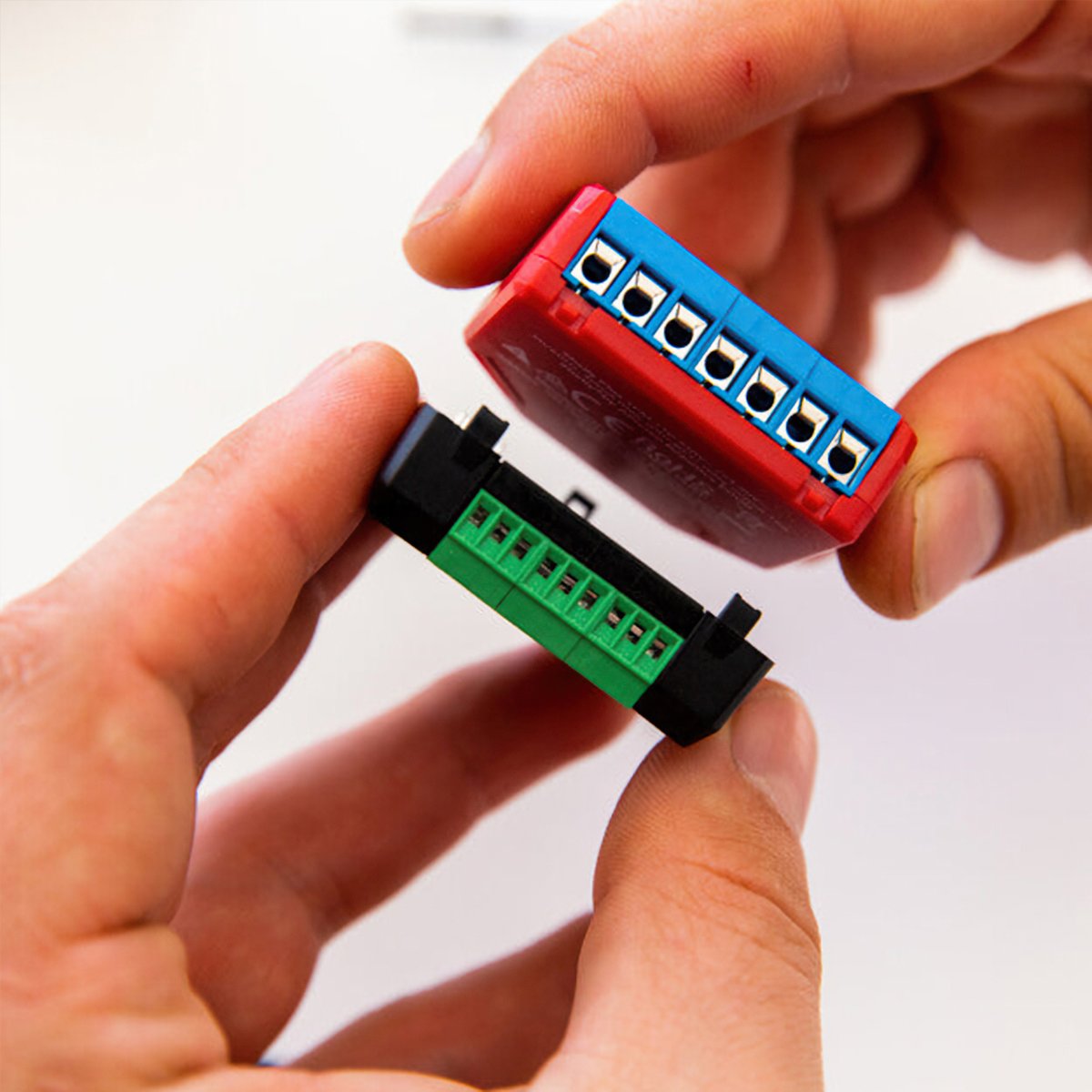
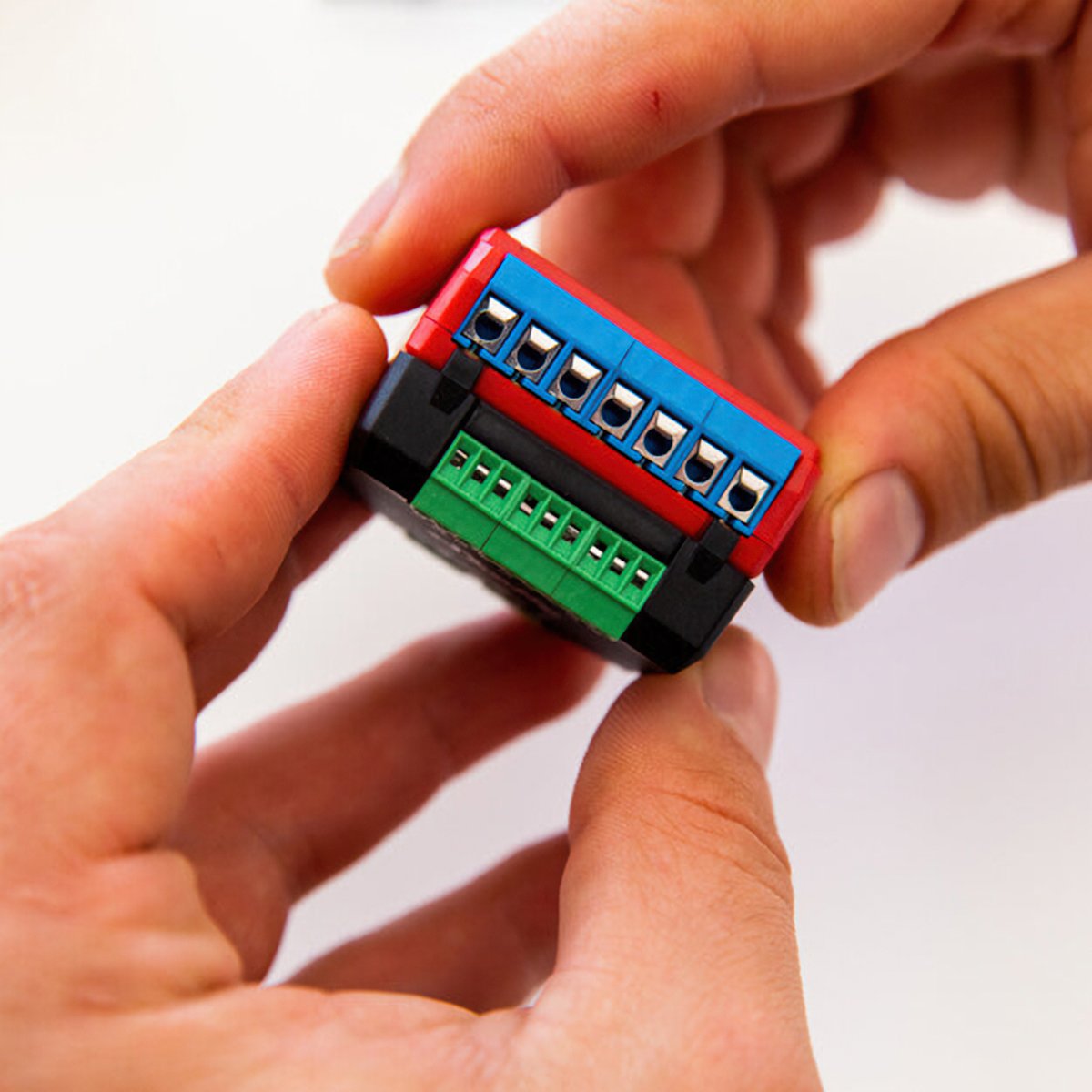
Clips onto the Shelly you already have
Most people add one to hold a temperature: underfloor heating that keeps a slab at a set point, a bathroom fan that runs on humidity instead of a timer, a pump that waits on a float switch. The Add-On mounts alongside the Shelly it serves and connects to its add-on port, drawing 3.3 V from it. There's no second wall box and no supply of its own. It works with the Shelly Plus range, the Gen3 in-wall devices, and the Gen4 1, 1PM and 2PM.
- Up to five DS18B20 temperature probes, or one DHT22
- Analog and digital inputs for PIR, soil moisture, light and 0 to 10 V sensors
- Powered by the host device, fits the same wall box
- Galvanically isolated from the mains side
How Shelly works

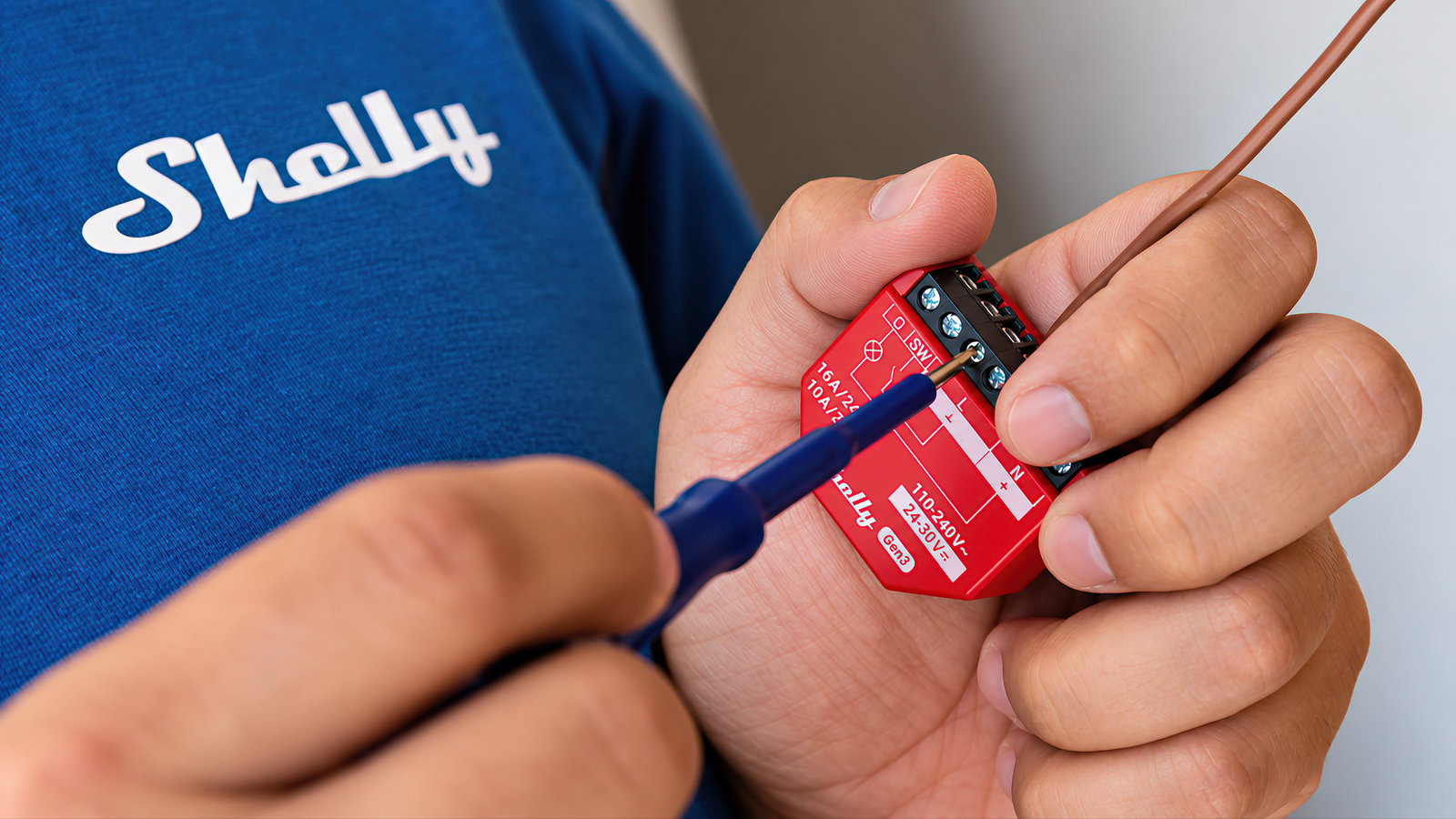
A Shelly is a small module that makes wiring you already have controllable. It joins your Wi-Fi directly, holds its schedules and scenes on the device itself, and keeps running them if your internet drops. Nothing you set up depends on Shelly's servers being reachable.
The device
The brain is the device
Shelly does the thinking locally, not in a data centre. Schedules, scenes and logic are stored on the unit and run there, so the lights still come on at dusk when the internet is out.
The network
No hub, no bridge
There is nothing to buy before the first one works. Where a Philips Hue setup is built around a Bridge that every light talks through, a Shelly joins your router directly and answers your phone from there.
The control
The app is optional
Every Shelly serves its own web interface, so you can set it up and run it from a browser on your own network, with no account. The Shelly Smart Control app and Shelly Cloud are free and add remote access and voice control, but nothing needs them.
The generations
What Gen1 to Gen4 means
Shelly has run through four hardware generations, and the same product name can exist in more than one of them. Later generations are faster and carry more radios than the ones before, which is why the generation is part of the name. The specifications on each page tell you which one you are looking at.
Getting started
1
It goes behind what you already have Start here
Shelly retrofits. The module fits behind the switch, socket or appliance that is already there, so your switch plates and fittings stay as they are and the original switch keeps working for anyone who just wants to flick it. Anything wired into a mains circuit is a job for a licensed electrician.
2
Open by design Then run it your way
Shelly publishes its local API and does not put it behind a developer account. Devices answer HTTP and MQTT on your own network and can run small scripts on themselves. That is why Shelly is the default choice for people building on Home Assistant, which ships an official Shelly integration.
Start with one and add more whenever you like. There is no hub to outgrow, and each Shelly works on its own whether you ever add another or not.
Specifications & Installation
Setup · 1:47
How to install it
Shelly's install walkthrough for the Plus Add-On, fitted with a DS18B20 temperature probe.
Watch setup videoNo specifications match.
Power
- Power
- Hardwired
- Standby power
- < 0.5 W
- Accessory type
- Add-on module
- Adds
- Temperature probe inputHumidity sensor inputDigital inputAnalog input
- Fits
- Shelly Plus, Gen3 in-wall and Gen4 1/1PM/2PM devices
- Connections
- Screw terminals
- Housing material
- Plastic
- Operating temperature
- -20–40 °C
- Operating humidity
- 30–70 % RH
- Max altitude
- 2000 metres
- Size (HxWxD)
- 37x42x15 ±0.5 mm / 1.46 x 1.65 x 0.59 ±0.02 in
- Weigh
- 105 g / 3.70 oz
- Screw terminals max torque
- 0.1 Nm / 0.89 lbIn
- Conductor cross section
- max. 1 mm² / 17 AWG
- Conductor stripped length
- 4.5 mm / 0.18 in
- Color
- Black
- Power supply voltage AC
- N/A
- Power supply voltage DC
- 3.3 V (from Shelly plus device)
- VCC max. current
- 10 mA
- VREF OUT max. current
- 1 mA
- VREF+R1 OUT resistor
- 10 kΩ
- Shelly Plus Addon supporting devices
- **Shelly Plus devices:** * Shelly Plus 1 * Shelly Plus 1PM * Shelly Plus 1 UL * Shelly Plus 1PM UL * Shelly Plus 2PM * Shelly Plus 2PM UL * Shelly Plus i4 * Shelly Plus i4DC * Shelly Plus 0-10V Dimmer * Shelly Plus RGBW PM
- Shelly Plus Addon supporting devices
- **Shelly Gen3 devices:** * Shelly 1 Gen3 * Shelly 1PM Gen3 * Shelly 2PM Gen3 * Shelly Shutter * Shelly i4 Gen3 * Shelly DALI Dimmer Gen3 * Shelly Dimmer 0/1-10V PM Gen3 * Shelly EM Gen3
- Shelly Plus Addon supporting devices
- **Shelly Gen4 devices:** * Shelly 1 Gen4 * Shelly 1PM Gen4 * Shelly 2PM Gen4
- Temperature reading
- Depends on the DS18B20 or DHT22 sensors
- Humidity reading
- Depends on the DHT22 sensor
- Digital input
- -15 V to 0.5 V (True) / 2.5 V to 15 V (False)\*
- Analog input range
- 0 to 100%
- Analog input report threshold
- 1%\*\*
- Voltmeter range
- 0 to 10 V
- Voltmeter report threshold
- 0.1 V\*\*
- Analog input / Voltmeter accuracy
- Better than ±5%
- SKU
- SHE-ACC-0003
- Barcode
- 3800235266427
Wiring diagrams
Circuit overview
Brown: power (VCC)White: ground (GND)Yellow: moisture (ANALOG IN)Green: temperature, not connected
In Australia, fixed 230 V wiring is licensed-electrician work. Use these diagrams to plan the job and brief your electrician.
Showing the whole circuit
What you can do with it

A roof-space fan that runs when the roof gets hot
A temperature probe in the roof space switches the exhaust fan on when the air up there gets hot, and off again once it cools. It runs on the relay itself, so it keeps working without the internet. Control with any of


Run the pool pump when it costs less
The pool pump is one of the hungriest circuits in most houses, so schedule its runs into off-peak windows and see what each one uses. Changing the season's run times happens from the couch, not the pump shed. Control with any of 
Water the garden on a schedule
The relay's dry contact drives standard irrigation solenoids, so beds and lawn water on a schedule without a dedicated controller. Rain coming? Skip the next run from your phone. Control with any of Common questions
Quick answers before you buy. We test this gear ourselves. Can't find yours? Ask our Melbourne team
A Shelly on its own can switch and schedule. The Add-On gives it senses, so it can react to temperature, humidity, moisture or a contact closing.
The Shelly Plus range, the Gen3 in-wall devices, and the Gen4 1, 1PM and 2PM. It won't work with the Pro DIN-rail range, which has its own add-ons.
No. The Add-On is the interface; the probes are bought separately. We stock the DS18B20 temperature probe.
Up to five DS18B20 temperature probes on the one-wire bus, or a single DHT22, plus one analog and one digital input.
Yes. It installs in the wall box alongside a mains-wired Shelly, so it's electrical work.
Shelly · Plus Add-On