






Explainer Ecosystems
Apple Home automations and their limits
Apple Home automations run on a hub in your house: arrivals, departures, times and accessory triggers. What each trigger can do, and where the honest ceiling sits.
Automations are the point of a smart home: the lights that come on when the sensor sees you, the heater that warms the study before you sit down, the lock that secures itself when the last person leaves. Apple Home does all of this competently, with less fuss than any rival, and it does it on one condition: there is a home hub in the house. This page covers what the automation engine offers, what each trigger needs, and where its honest ceiling is.
The hub condition
Automations run on the hub, not on your phone, which is what lets them fire while you are asleep or away. On the current version of Apple Home the hub is an Apple TV 4K, a HomePod or a HomePod mini; an iPad no longer qualifies, and whether you need a hub at all depends on what you want the home to do. No hub, no automations: a hubless household can control accessories by hand from an iPhone, but nothing will happen by itself.
If that sends you shopping, the two-list catch between hubs and Thread border routers is worth two minutes.
The four triggers
The Home app builds automations from four trigger types.
- People arrive. Somebody's iPhone crosses into home. Good for lights-on, climate-up, unlock-adjacent conveniences.
- People leave. The reverse, and the more valuable of the pair: last-person-leaves is how heaters, straighteners and forgotten lights get turned off.
- A time of day. Time triggers can carry occupancy conditions, so 'at this time, only if someone is home' is one automation, not two.
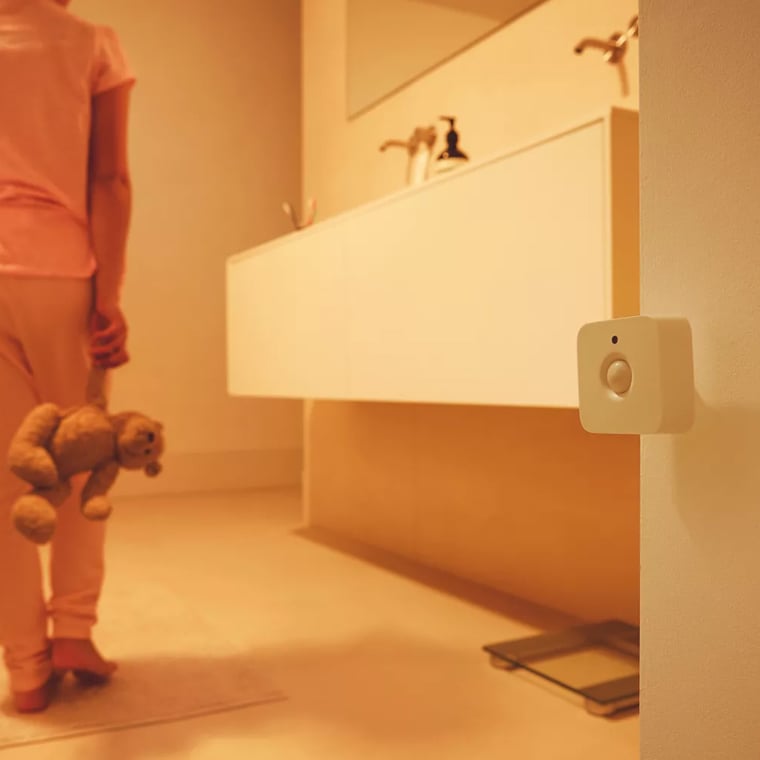
- An accessory is controlled. A sensor changes, a door opens, a switch is pressed. This is how sensor-driven automations are built; there is no separate sensor trigger, the sensor is the accessory.
Two useful refinements ride along. An accessory turned on by an automation can be given a duration, so the laundry light gets three minutes rather than a lecture. And one automation can run whole scenes and several accessories together, so 'arrive home' can mean lights, climate and music in one rule.
The location triggers have prerequisites people trip on: Location Services on, and Share My Location enabled on the iPhone or iPad you nominate as primary. A Mac cannot supply its location to automations, however permanently it sits on the desk.
Building your first automation
- Confirm the home has a hub
An Apple TV 4K, HomePod or HomePod mini must be set up in the home, or nothing below will run.
- Open the Home app and start a new automation
Automations have their own section of the app.
- Pick one of the four triggers
For a first automation, People Leave is the most satisfying: lights off and heater off when the last person goes.
- Add conditions if the trigger takes them
A time trigger can carry an occupancy condition; for the location triggers, turn on Location Services and Share My Location on the iPhone or iPad you nominate as primary.
- Choose what runs, and set a duration where it helps
An automation can run scenes and several accessories together, and an accessory it switches on can be given a duration so it turns itself off.
Siri, and what is actually shipped in Australia
Voice control and automations are cousins, and the Australian position is precise. Siri on any Apple device can trigger scenes and control accessories. A HomePod or HomePod mini is what gives you that hands-free in a room, rather than into your wrist or phone.
Apple Intelligence has been available in Australia since December 2024, in localised Australian English, on recent iPhones, iPads and Macs; both the device language and Siri's language need to be set to a supported English. For the Home app, Apple describes it combining related notifications and letting you search camera footage by what happened. Note that it runs on those personal devices, not on the HomePod or Apple TV themselves.
The rebuilt Siri, announced as Siri AI, is not shipped. It belongs to an OS generation that has not shipped, so nothing on this page, and nothing you buy today, should be justified by it. When it ships to Australian customers, we will write it up then.
The honest ceiling
Apple publishes no limits for automations, scenes, accessories or rooms, and we will not repeat the numbers that circulate in forums, because they are not Apple's. In practice the ceiling you hit first is expressiveness, not quantity: the Home app's automation builder offers no nested conditions and no variables, no 'if this and also that, unless the other'. Each automation is a single rule.
For most households that is a feature. If you are the household that wants motion-gated lighting with lux thresholds, presence-weighted heating and notifications that depend on three sensors at once, the answer is not to fight the Home app; it is to run Home Assistant for the logic and keep Apple Home as the friendly front end. That pairing, and when it is worth the effort, is its own article.
Frequently asked questions
Do Apple Home automations need a hub?
Yes. Automations run on a home hub, an Apple TV 4K or a HomePod, which is why they keep working while you are out. An iPad does not qualify on the current version of Apple Home.
What triggers does Apple Home support?
Four: people arriving, people leaving, a time of day (with occupancy conditions), and an accessory being controlled. Sensor-driven automations use the accessory trigger.
Can Apple Home turn something off after a set time?
Yes. An accessory switched on by an automation can be given a duration, so it turns itself off after a period you choose.
Do I need Apple Intelligence for automations?
No. Automations are a platform feature and run on the hub. Apple Intelligence adds conveniences Apple describes for supported iPhones, iPads and Macs, combining related Home notifications and searching camera footage by what happened, and it has been available in Australia since December 2024.
What can't Apple Home automate?
Anything needing nested logic: multiple conditions, variables, or rules that depend on several sensors at once. The Home app builds automations as single rules. Households that outgrow that usually run Home Assistant for the logic and keep Apple Home as the everyday interface.
Still need a hand?
We answer most messages within one business day. If your question is about an existing order, have your order number ready. It speeds things up.
Contact us